
Session goals
- reduce muscle pressure
- help stiff areas feel looser
- support range of movement
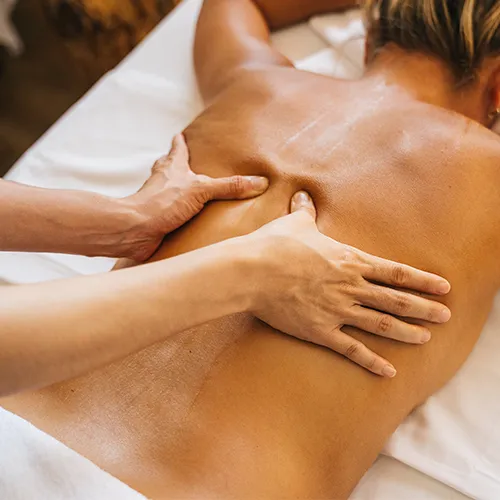
A deep tissue massage uses slower, focused pressure on areas that feel stubbornly tight. This treatment is often chosen for muscular load linked to desk work, repetitive movement, or sports.
We build intensity carefully and keep the pressure within your limits, so the session stays firm but manageable. A short-lived tender or workout-like feeling afterward can be normal after a more intensive treatment.
Not sure whether deep tissue is the right choice? Then also read our comparison therapeutic massage vs. deep tissue and our guide about deep tissue massage for tight muscles.
Compare the treatment's focus, intensity, suitability, and practical details before you book.
Practice in Sint-Job-in-'t-Goor, easily reached from Brecht, Hoogstraten, Kapellen, Schoten, Wuustwezel, Malle, Schilde, Zoersel and Brasschaat.
The session starts by identifying the areas that feel most loaded or restricted. The therapist first warms the area and then works more slowly and precisely. Pressure increases in stages; harder pressure is not a goal in itself and should never feel sharp or uncontrollable.
We keep checking pressure, breathing, and movement comfort throughout the treatment. Focusing on one or a few clearly defined areas usually provides a more purposeful session than trying to work every muscle at maximum intensity.
Mention a recent injury, inflammation, unexplained pain, loss of sensation, or ongoing medical treatment in advance. Acute symptoms or uncertainty should be medically assessed before massage.
Temporary tenderness or a workout-like feeling can occur after firmer work. Gentle movement is generally more comfortable than immediately loading the treated muscles heavily. Contact a healthcare professional if pain increases significantly or does not resemble ordinary short-lived tenderness.
Our massages are non-medical wellbeing treatments adapted to tension, stiffness, fatigue, and the need for relaxation.
Sources for boundaries and precautions: NCCIH on massage safety, NCCIH on cupping, and ACOG on massage during pregnancy.