
Therapeutic massage vs. deep tissue: what is the difference?
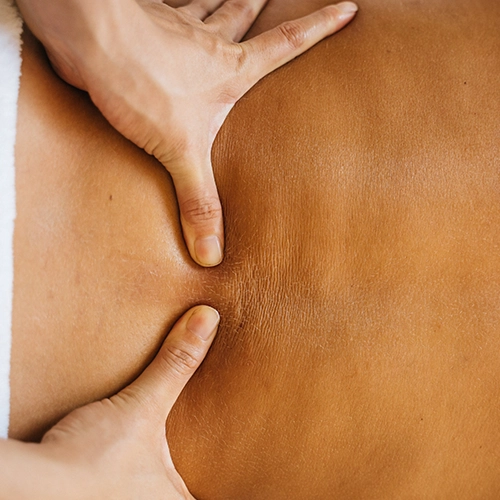
When people look for a more targeted massage for tension, tight muscles, or recurring pain points, they often end up with two terms: therapeutic massage and deep tissue. Those terms are often used as if they mean the same thing. They do not.
deep tissue is a more specific and usually firmer approach. Therapeutic massage is broader: it is a complaint-focused treatment where technique, pressure, and focus are adapted to what your body actually needs. This page helps make that distinction clearer, so you do not automatically choose the strongest option, but the most suitable one.
Key points
- Therapeutic massage is a broader, complaint-focused approach that can be soft, medium, or firm.
- deep tissue is a more specific technique aimed mainly at deeper tension and stubborn muscle knots.
- Not every tight muscle calls for deep tissue; sometimes a broader or gentler therapeutic treatment is the smarter choice.
- The right choice depends on your complaint pattern, sensitivity, and whether the tension feels local or deep.
Table of contents
- What do we mean by therapeutic massage?
- What makes deep tissue more specific?
- The differences in short
- When is therapeutic massage the better choice?
- When is deep tissue the better choice?
- What if your muscles mainly feel stiff and tight?
What do we mean by therapeutic massage?
Therapeutic massage is not one fixed technique. It is a way of working that starts from your complaints, sensitivity, and goal: less tension, more mobility, local relief, or a better mix of relaxation and recovery.
At NaSiam, our Thai therapeutic massage comes closest to that idea. It can combine targeted pressure, stretching, and local focus without everything automatically having to feel “as deep as possible.”
That broader character is exactly its strength. Someone with shoulder tension from desk work, stress-related tightness, or a body that reacts strongly to pressure often benefits more from a session that can adjust and vary than from going immediately for the firmest option.
What makes deep tissue more specific?
deep tissue is a more specific type of treatment. The focus is on deeper tension in muscles and connective tissue, often with slower and more targeted pressure. The goal is not to be hard for the sake of being hard, but to treat areas that have stayed tight for a long time more precisely.
Our deep tissue massage is therefore mainly chosen for stubborn muscle knots, reduced mobility, and tension that feels compact, deep, or recurring. Especially in the neck, shoulders, upper back, lower back, and legs, that can be a logical choice.
deep tissue is therefore not “the better therapeutic massage,” but rather a firmer sub-choice within a complaint-focused approach.
The differences in short
Purpose Therapeutic massage looks for the most suitable approach for your complaint. deep tissue focuses more specifically on deeper muscular tension and stubborn knots.
Intensity Therapeutic massage can be soft, medium, or firm. deep tissue is usually medium to firm and works more slowly on tight zones.
Focus Therapeutic massage can work locally or more broadly, depending on your pattern. deep tissue is especially useful when one area keeps staying stuck.
Experience Therapeutic massage leaves more room for variation between relief and calming. deep tissue often feels more intense and precise, sometimes with mild after-sensitivity.
When is therapeutic massage the better choice?
Therapeutic massage often makes more sense when the complaint is not only deep, but also connected to posture, stress, or broader overload. That is often the case when:
- tension shifts between several areas
- you are not fully sure where the main source sits
- your body reacts sensitively to a lot of pressure
- you are planning a first complaint-focused session and do not yet know how firm it should be
In those situations, a broader therapeutic approach is often smarter than starting immediately with the most intense option.
When is deep tissue the better choice?
deep tissue is often the better fit when the tension keeps returning to the same place and a regular relaxation massage no longer seems to do enough. That is often the case when:
- you feel clear muscle knots or trigger-like areas
- your neck, shoulders, or lower back keep feeling hard and compact
- your range of motion is clearly becoming smaller
- sports, desk work, or repetitive load keeps overloading the same zone
For that kind of pattern, deep tissue can be very suitable because it works more slowly and specifically. If you want to go deeper into that, our guide about deep tissue massage for tight muscles gives extra context.
What if your muscles mainly feel stiff and tight?
Then it helps to read the pattern first instead of choosing a label immediately. Tight muscles do not automatically mean deep tissue is needed. Sometimes the body mainly needs rest, sometimes local focus, and sometimes a firmer approach.
Our guide always tight muscles? 6 signs your body is holding on to tension helps make that distinction clearer. If the complaints mainly sit in the neck, shoulders, and upper back, back, neck, and shoulder massage may even be more logical than a broader session.
Practical next step at NaSiam
If you mainly want to explore a broader complaint-focused approach, start with Thai therapeutic massage. If you are specifically looking for a firmer treatment for deeper tension, go to our deep tissue massage page.
If you are still unsure, it is usually smarter to compare the price list and the treatment pages side by side. That way, you choose based on what your body probably needs today instead of choosing by buzzword alone.
Frequently asked questions
Is deep tissue always painful?
No. deep tissue can feel intense, but it should never feel unbearable. The pressure should be adapted to your breathing, muscular response, and feedback.
Is therapeutic massage automatically softer?
No. Therapeutic massage can also be firm. The main difference is that the treatment is adapted more broadly to your complaint instead of automatically working deeply.
What if i am not sure which treatment fits?
Then comparing is better than guessing. In that case, a broader therapeutic session or a clear intake is usually the safest first step.
Can i exercise right after deep tissue?
It is usually smarter to give your body a bit of rest, especially after an intensive session. Gentle movement is fine, but heavier load is better postponed for a while.

Author, reviewer and approver
Nalita Mangtaku
Thai massage therapist, owner & founder
Nalita Mangtaku has practised massage since 2009 and is the founder of NaSiam. Her favourite treatments are therapeutic Thai massage, sports massage, and relaxation massage. She describes her style as flowing, healing, and energetic.
Therapeutic, with clear boundaries
Our massages are non-medical wellbeing treatments adapted to tension, stiffness, fatigue, and the need for relaxation.
- We start with a short intake and adjust pressure, pace, and techniques to your comfort level and situation.
- Massage may support relaxation and temporary body comfort; it does not diagnose conditions or replace a doctor, physiotherapist, or rehabilitation.
- Always mention pregnancy, recent surgery, fever or infection, acute injury or inflammation, skin wounds, blood thinners or a bleeding disorder, and unexplained or increasing pain beforehand.
- Firm massage, deep tissue, and cupping require extra caution; cupping can cause temporary discoloration, scars, burns, or infections.
- Seek medical help for severe or rapidly increasing pain, numbness or weakness, clear swelling, chest pain, or breathing difficulty; do not wait for a massage appointment.
Sources for boundaries and precautions: NCCIH on massage safety, NCCIH on cupping, and ACOG on massage during pregnancy.
- Massage
- Health
- Wellness