
Thai sports massage for recovery and muscle load
17 April 2026 | Nalita Mangtaku
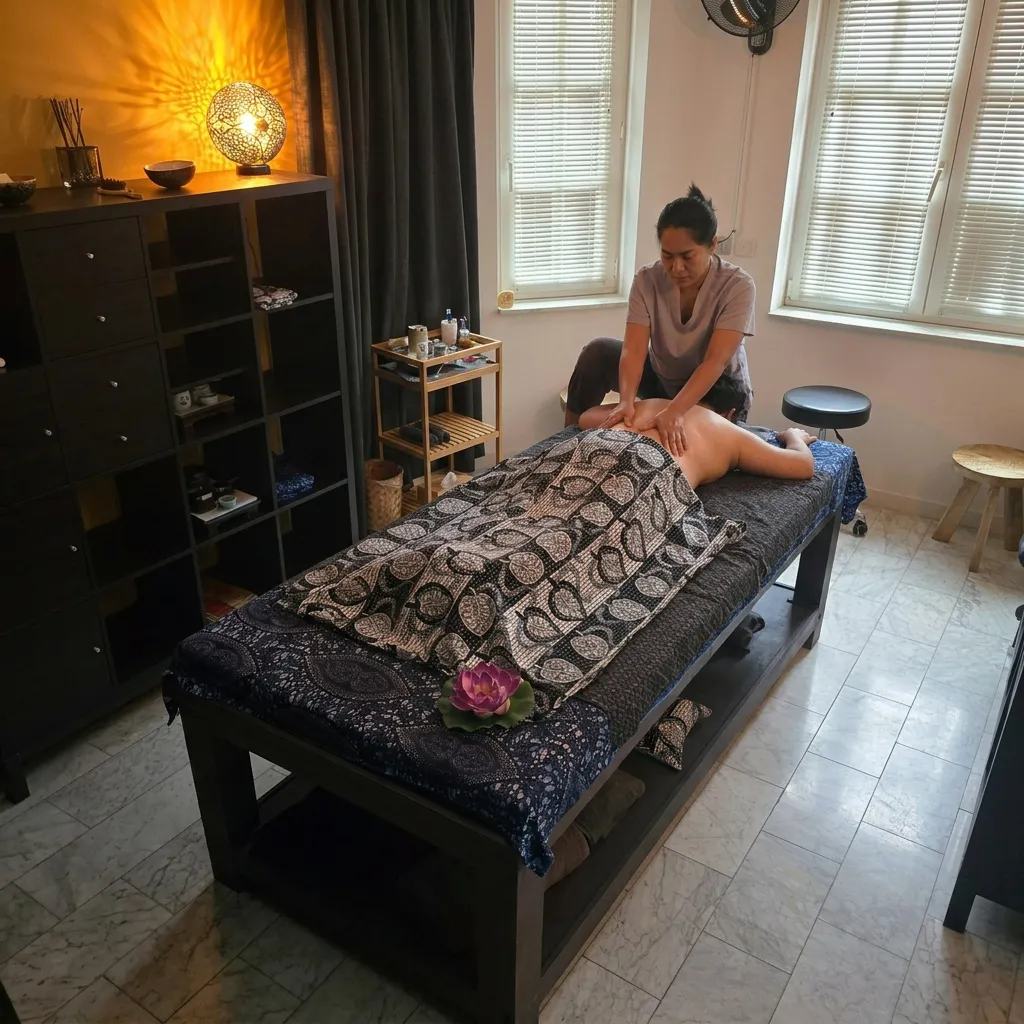
If you train regularly, do physical work, or simply put your body under steady strain, you are usually not looking for “just a firm massage.” What you want is clarity: what actually helps when your muscles feel tired, your legs feel heavy, or your body does not seem to release properly after training? Thai sports massage becomes relevant there, not because it sounds tougher, but because it is built around focused technique, controlled pressure, and a logical recovery-oriented approach.
At NaSiam in Sint-Job-in-’t-Goor, we notice that clients from Brecht, Brasschaat, Schilde, and Schoten often need nuance more than slogans. Not every form of muscle load asks for the same treatment. Sometimes a focused sports massage fits best, and sometimes deep tissue massage makes more sense. In this article, you will read when Thai sports massage is genuinely relevant, why expertise matters so much within this treatment style, and how Nalita’s recognition in sports massage makes that trust more tangible.
Key takeaways
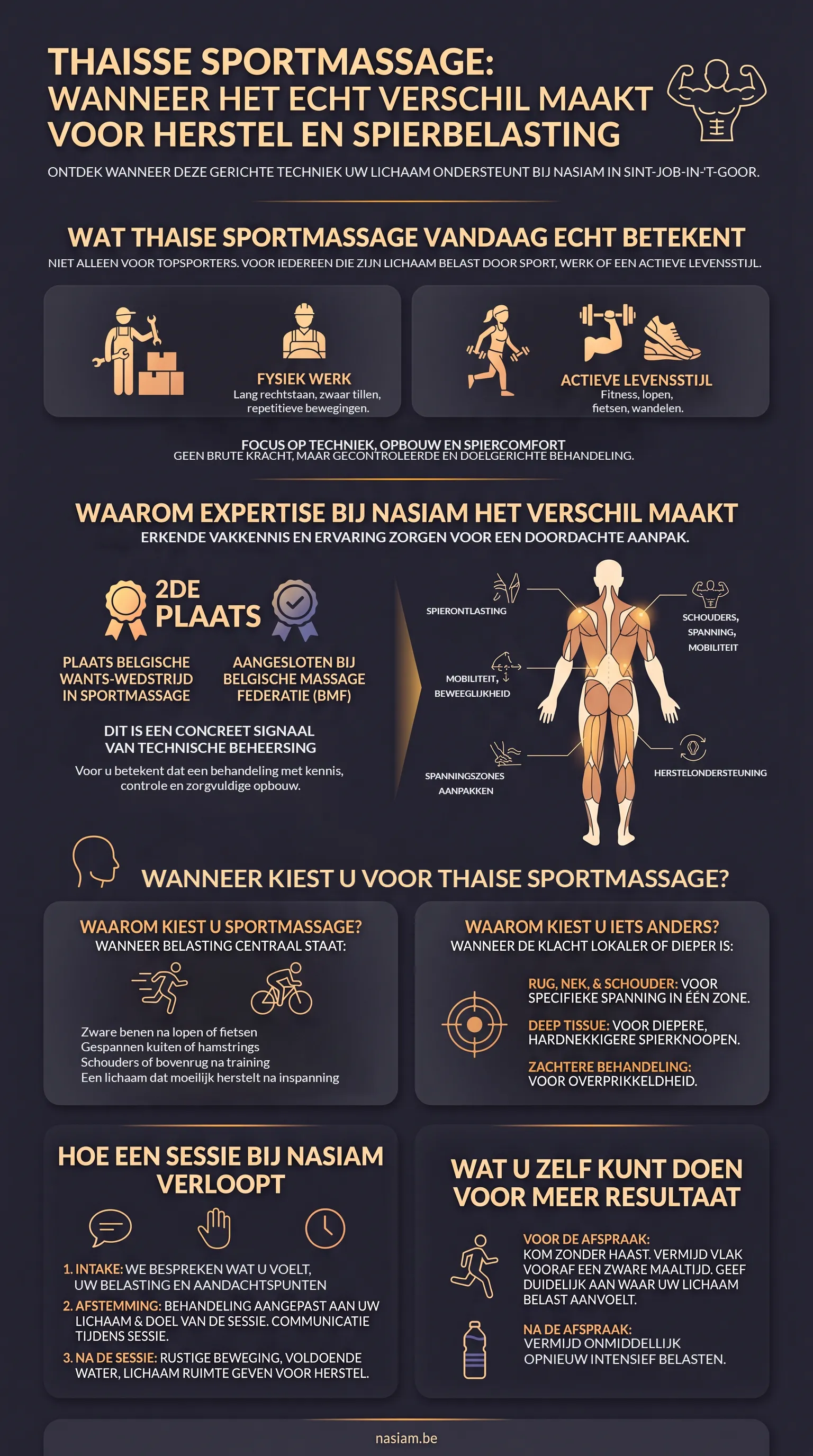
- Thai sports massage is designed for muscles under load through sport, work, or an active lifestyle, not only for high-level athletes.
- The quality of the treatment lies in dosage, timing, and technique, not in how hard someone can press.
- Authority is not a marketing word here; the background of the therapist directly affects how safe and purposeful the treatment feels.
- Nalita’s recognition in sports massage strengthens that trust because it offers a concrete external sign of technical control.
- Not every complaint calls for sports massage; when tension is very local or especially stubborn, another treatment may fit better.
Table of contents
- What Thai sports massage really means today
- Why expertise in Thai sports massage is not a detail
- When should you choose Thai sports massage and when should you not?
- How a session at NaSiam actually works
- What you can do yourself to get more out of it
What Thai sports massage really means today
Many people hear “sports massage” and immediately picture a short, hard treatment that is mainly there to pound muscles loose. That image is too limited. In a professional setting, Thai sports massage is about treating muscles that feel loaded, with attention to rhythm, direction, pressure build-up, and the way a body responds from one zone to the next. That also fits the broader massage landscape as described by the National Center for Complementary and Integrative Health : massage comes in different forms, and the purpose depends on the technique and the physical situation.
At NaSiam, that nuance matters. A treatment only becomes valuable when it fits what your body actually needs that day. That is why Thai sports massage does not stand apart from the tradition of traditional Thai massage, but also not apart from practical questions around muscle load, recovery feel, and comfort after exertion.
Not only for people with a serious training schedule
The name makes it sound as if this treatment is only meant for people who run races, cycle long distances, or spend hours in the gym. In practice, we see a much broader group:
- people with physically demanding work who lift a lot or stand for long periods
- recreational athletes with tired calves, hamstrings, or shoulders
- people combining desk work with regular training
- active clients who notice that their body keeps feeling heavy after exertion
That is why defining sports massage too narrowly does not help. It is less about your athletic identity and more about your pattern of load. A body can tighten up just as easily from padel, renovation work, gardening, or long workdays as from a structured workout plan.
Not brute force, but focused progression
A good Thai sports massage is not about proving how strong the therapist is. The real quality lies in how pressure is built up, how an area is prepared, and how surrounding structures are read along with the main complaint. That control is exactly what separates a treatment that merely feels “firm” from one that also feels logical.
That is why it makes sense to be careful with practices that sell sports massage mainly as “extra hard.” A loaded muscle often needs precision, not spectacle. And a therapist who works professionally also knows when less pressure creates the better result.
Why expertise in Thai sports massage is not a detail
With a relaxation massage, people sometimes assume atmosphere is almost everything. With sports massage, that changes quickly. As soon as the goal shifts toward muscle load, mobility, and recovery feel, technical control becomes much more important. You want someone who understands what they are doing, where tension may be coming from, and how far a treatment can safely and usefully go.
That is also why external signs of expertise matter. You can look at Nalita’s background, but also at her profile with the Belgian Massage Federation , where she is listed as an affiliated therapist and sports masseur. That kind of information does not replace your own experience, but it does make expertise more concrete.
Authority is created through control, not big words
Real authority usually feels calmer than inflated copy. It shows up in clear explanation, in naming limits honestly, and in avoiding exaggerated promises. Someone who communicates professionally about sports massage does not claim that one session will solve injuries or guarantee performance.
What you can reasonably expect is a treatment that supports the body around load and recovery. That may show up as more comfort, muscles that feel less heavy, a looser sense in specific areas, or simply a body that settles more quickly after a demanding week. But it remains bodywork within a wellbeing framework.
Nalita’s second place makes expertise tangible
That is exactly why the reference to Nalita’s recognition in sports massage matters here. In the blog post about Nalita taking second place in sports massage at the first Belgian WANTS competition, you can see how that recognition is framed. It shows that her work is not only appreciated locally, but also visible in a broader professional context.
That competition was connected to the World Association of Nuad Thai and Spa , an organization that promotes Nuad Thai internationally. That does not mean a podium finish says everything, but it does create an external reference point for technical quality. For you as a client, that translates into something very practical: more confidence that the hands behind the treatment are not only experienced, but also demonstrably trained and controlled in their approach.
When should you choose Thai sports massage and when should you not?
Not every kind of muscular tension calls for sports massage. Sometimes the body feels heavy and loaded, but the main need is actually general calm. Sometimes sports massage sounds like the obvious choice while a more local treatment would fit better. That is exactly why choosing well matters more than choosing the strongest-sounding option.
What does research say about sports massage?
Sports massage may feel helpful when muscles feel heavy or stiff after activity, but expectations should remain realistic. A systematic review and meta-analysis in BMJ Open Sport & Exercise Medicine found no direct benefit for strength, sprint performance, endurance, or fatigue. It did find small improvements in flexibility and delayed-onset muscle soreness. That can support comfort and the recovery experience, but it does not show that massage repairs damaged tissue faster or prevents injury.
The claim that massage “flushes out lactic acid or toxins” is not a sound explanation either. Its practical value is better described in terms of focused touch, relaxation, temporary flexibility, and how the body feels after load.
Choose sports massage when load is the main story
Thai sports massage often makes sense when your body mainly feels loaded, tired, or stiff after activity. Think of:
- heavy legs after running or cycling
- tense calves or hamstrings after training
- shoulders or upper back that stay tight after strength work
- an active body that does not switch off easily after exertion
In those situations, the main question is often not, “Where exactly is the pain?” but rather, “Why does my body keep holding so much tension?” That is where a treatment focused on recovery feel and muscle comfort often becomes the better fit.
The sport itself also changes the context. Runners and cyclists often notice load in the calves, thighs, or hamstrings, while strength training places different demands on the back, shoulders, and legs. With padel and team sports, the need may be more general. Massage can support comfort in each case, but it is not treatment for an acute ankle sprain, Achilles injury, shin injury, or concussion.
Choose something else when the complaint is more local or more sensitive
Sometimes the pattern is different. If your tension is mainly concentrated in one clear area, for example between the neck and shoulder blade, a back, neck, and shoulder massage may be more suitable. If the tension feels denser, deeper, and unchanged for a longer time, deep tissue massage may be the better choice. And if your body is mainly overstimulated or very pressure-sensitive, a gentler treatment can be more effective on that day than a sports-focused session.
The key insight is simple: the right massage is not automatically the firmest one. It is the one that fits the way your load is showing up in your body today.
How a session at NaSiam actually works
A professional session does not begin on the table. It begins with the intake. First we look at what you are feeling, how recent or recurring the load is, which areas are sensitive, and whether there are any points of attention such as an injury, inflammation, or clear pressure sensitivity. Those first minutes make the difference between a standard treatment and one that is actually adjusted to you.
At NaSiam, that means you do not get pushed into a fixed template. Two clients can both book “sports massage” and still receive a meaningfully different structure. That is not inconsistency. It is a sign that the treatment is being listened to and dosed properly.
Structure, communication, and adjustment
During the session, tension is usually not attacked head-on immediately. First the tissue gets the chance to respond, and then the work becomes more specific in the areas that continue to feel loaded. Communication remains essential all the way through: does this feel focused, too sharp, too intense, or not enough? Professional sports massage is always a cooperation between technique and feedback.
A therapist with real control can feel when a muscle is still bracing protectively, when surrounding areas need to be included, and when more pressure adds nothing useful. That is how Thai sports massage becomes a thoughtful treatment rather than a rough intervention.
Good accessibility makes consistency more realistic
Authority is not only about technique. It is also about reliability and practical ease. For clients in the Voorkempen, it helps that NaSiam in Sint-Job-in-’t-Goor is easy to reach. On the access & parking page, you can see how to arrive calmly and without unnecessary extra stress.
That is not a minor detail. Especially around recovery from work or sport, consistency is often more valuable than one exceptionally intense treatment. A practice that feels nearby, clear, and professional lowers that threshold.
What you can do yourself to get more out of it
Even the best massage works better when the surrounding conditions are right. You do not need a perfect recovery protocol, but a few simple choices often make a real difference in how your body processes the session.
Before the appointment
Try not to arrive in a rush. Avoid a heavy meal right beforehand and explain clearly where your body feels loaded. The more clearly you can describe the pattern, the more precisely the session can be built.
After the appointment
After a sports massage, it usually helps to give your body some room. Gentle movement, enough water, and not forcing it again immediately often make more sense than trying to “test” whether everything is fixed right away.
If you want to support your body more consistently, it helps to review the price list in advance and choose a rhythm that realistically fits your work, sport, and schedule. That kind of workable consistency is what turns massage into sensible maintenance for many people rather than a last-minute emergency solution.
Experience Thai sports massage at NaSiam
If you are not looking for tough-sounding marketing language, but for a treatment that is technically sound, professional in feel, and logically matched to muscle load, then Thai sports massage at NaSiam is a strong option to explore. You do not need to be a top athlete. You simply need to feel that your body is asking for support that is more focused than a standard relaxation session.
If you want to know whether sports massage, deep tissue, or another treatment fits your situation better, you can start with our price list. From there, we can help plan a session that is not only firm enough, but above all correctly chosen. That is what real authority in massage ultimately comes down to: not sounding impressive, but doing the right thing professionally at the right moment.
Frequently asked questions about Thai sports massage
What exactly is Thai sports massage?
Thai sports massage is a targeted treatment for muscles under load through sport, work, or an active lifestyle. The emphasis is on technique, structure, muscle comfort, and recovery feel, not on simply working as hard as possible.
Is Thai sports massage only for athletes?
No. People with physically demanding work, active hobbies, or recurring muscular tension often choose this approach as well, because the treatment is aimed at load and recovery around specific muscle groups.
When does Thai sports massage make more sense than deep tissue?
Thai sports massage often fits better when your muscles feel tired, heavy, or loaded after training or activity. deep tissue is usually more suitable when tension is deeper, more compact, and stuck in a more localized problem area.
Is Thai sports massage always firm?
No. The pressure is adjusted to your body, your sensitivity, and the goal of the session. A good treatment should feel focused and useful, but it does not need to feel harsh or painful to have value.
What does Nalita’s second place in sports massage mean for you as a client?
That result is a concrete sign of technical control and professional recognition. For you, it mainly means extra confidence that NaSiam works with knowledge, precision, and careful treatment structure.
How should you prepare for a session?
Try to arrive without rushing, avoid a heavy meal right beforehand, and explain clearly where your body feels loaded. Also mention injuries, sensitivities, or other points of attention so the treatment can be adjusted safely.
Therapeutic, with clear boundaries
Our massages are non-medical wellbeing treatments adapted to tension, stiffness, fatigue, and the need for relaxation.
- We start with a short intake and adjust pressure, pace, and techniques to your comfort level and situation.
- Massage may support relaxation and temporary body comfort; it does not diagnose conditions or replace a doctor, physiotherapist, or rehabilitation.
- Always mention pregnancy, recent surgery, fever or infection, acute injury or inflammation, skin wounds, blood thinners or a bleeding disorder, and unexplained or increasing pain beforehand.
- Firm massage, deep tissue, and cupping require extra caution; cupping can cause temporary discoloration, scars, burns, or infections.
- Seek medical help for severe or rapidly increasing pain, numbness or weakness, clear swelling, chest pain, or breathing difficulty; do not wait for a massage appointment.
Sources for boundaries and precautions: NCCIH on massage safety, NCCIH on cupping, and ACOG on massage during pregnancy.