
Sore After a Thai Massage? What Is Normal?
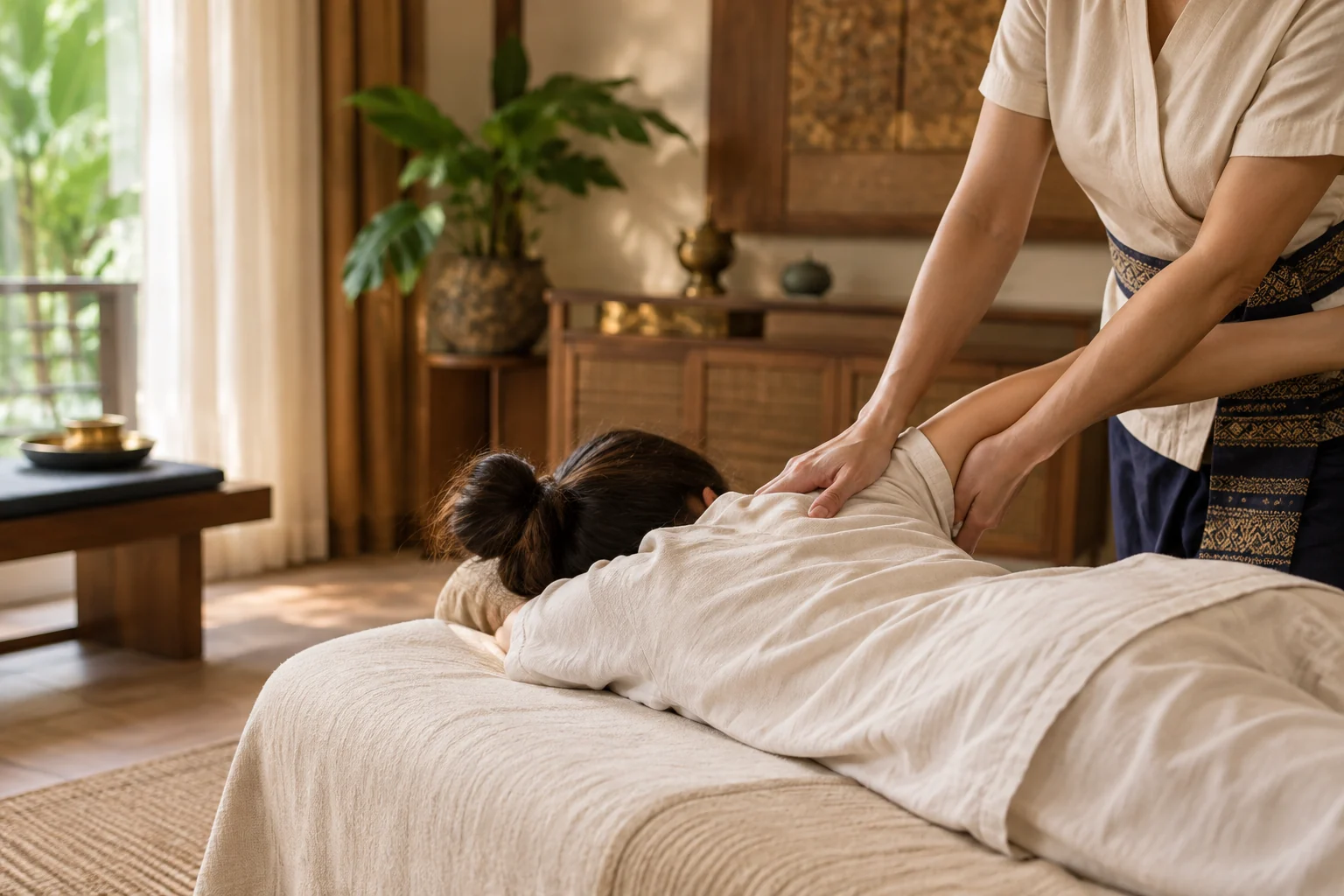
Mild muscle tenderness or stiffness can occur briefly after a Thai massage, especially after a first or firmer treatment. Sharp, severe or worsening pain is not a goal of massage and deserves attention. This guide explains what may fall within a normal response, what you can do and when it is better to contact a healthcare professional.
Key takeaways
- A mildly tender, stiff or tired feeling can occur temporarily after deeper work.
- The response should stay mild and improve, not become worse each day.
- Soreness does not prove that a treatment was better or more effective.
- Gentle movement and normal everyday hydration are usually enough aftercare.
- Severe pain, marked swelling, weakness, numbness or shortness of breath require medical attention.
- Tell your therapist exactly how you responded so pressure and technique can be adjusted next time.
Contents
- Is soreness after a Thai massage normal?
- Why can you feel sore?
- How long can tenderness last?
- What can you do yourself?
- When should you seek medical advice?
- How can you prevent an overly strong response?
Is soreness after a Thai massage normal?
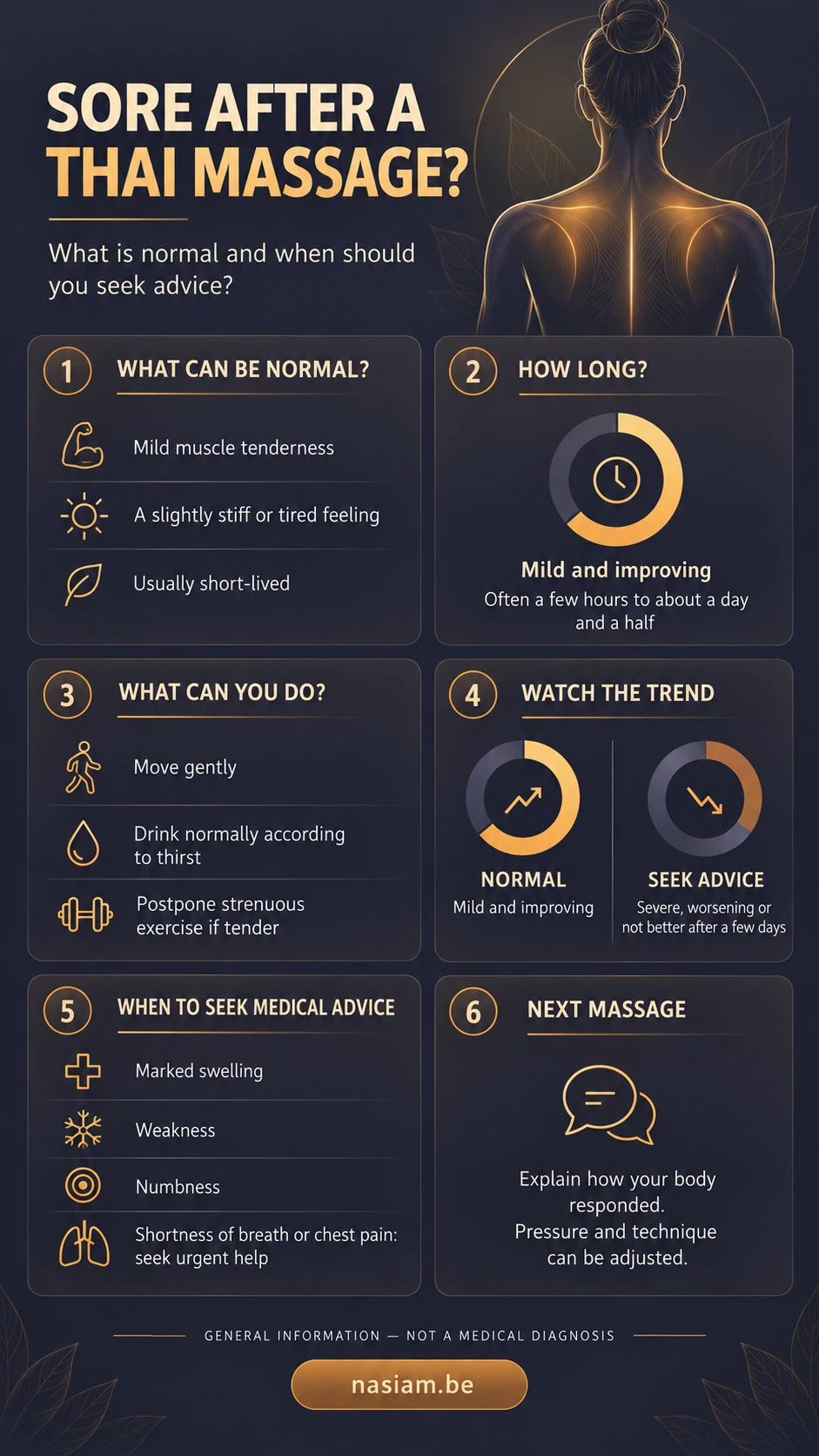
Mild, local tenderness can occur after massage. Muscles may feel slightly bruised when pressed, movement may be a little stiff or you may feel tired after an intensive session. This can be more noticeable after your first Thai massage, when you arrived with considerable tension or when a particular area received firm work.
Cleveland Clinic notes that mild post-massage soreness may last from a few hours to roughly a day and a half. Mayo Clinic also stresses that massage should not cause severe pain: uncomfortable or sharp pressure should be adjusted during the treatment.
There is therefore an important difference between temporary muscle tenderness and pain that alarms you, limits movement or keeps worsening. The latter is not something you should simply “push through.”
Why can you feel sore?
During traditional Thai massage, the therapist uses rhythmic pressure, compression, mobilisation and assisted stretching. Deep tissue massage focuses more on slow, targeted work in deeper tense areas. Both can feel more intense than a gentle relaxation massage.
A temporary response may relate to:
- Unfamiliar loading: muscles and surrounding tissue receive pressure and stretch they are not used to.
- Existing tension: a highly guarded area may be more sensitive to touch.
- Intensity and duration: longer or deeper work gives a stronger stimulus than a gentle session.
- Individual sensitivity: sleep, stress, previous physical load and health affect your response.
- Insufficient adjustment: tolerating excessive pressure without speaking up can unnecessarily irritate an area.
Soreness does not mean that “toxins were released,” nor does it prove that knots or blockages were removed. It mainly shows that your body noticed the stimulus. More pain does not automatically mean a better result. For the wider effects, read what Thai massage does to your body.
How long can tenderness last?
With ordinary muscle tenderness, the direction of change matters more than an exact number of hours. Symptoms should remain mild and gradually improve. Movement may already feel easier after a calm night, or a tender spot may react less than it did immediately after treatment.
Take the response more seriously when:
- pain feels sharp, throbbing, burning or electric;
- pain increases instead of easing;
- pain prevents normal movement or sleep;
- new swelling, marked bruising, tingling or numbness appears;
- intense tenderness does not clearly improve after a few days.
Cleveland Clinic recommends contacting a healthcare provider when intense soreness lasts more than a couple of days. This is not a remote diagnosis, but a useful boundary: when in doubt, have the symptoms assessed rather than dismissing them as “normal massage pain.”
What can you do yourself?
For mild and improving muscle tenderness, you usually do not need a special recovery protocol.
- Keep moving gently. A short walk or easy movement may feel better than sitting still for a long time. Do not force a painful stretch.
- Adjust your training. Postpone heavy strength work, intense running or demanding labour while the treated area remains tender.
- Drink normally according to thirst. Extra litres of water do not “flush toxins” and are not guaranteed to prevent soreness.
- Choose comfort. Warmth can feel relaxing; some people prefer brief cooling for a locally irritated feeling. Stop if anything worsens the symptoms.
- Record your response. Where were you tender, how long did it last and what pressure was used? That helps dose your next massage better.
When should you seek medical advice?
Massage is generally safe when properly performed and adjusted. However, the US National Center for Complementary and Integrative Health reports that serious adverse events are rare but possible, especially with vigorous techniques or in people at higher medical risk.
Contact a doctor or another appropriate healthcare professional for:
- severe or rapidly worsening pain;
- marked swelling, extensive bruising or a hot red area;
- new tingling, numbness or weakness;
- fever or feeling generally unwell;
- pain that does not ease after several days;
- a recent fall, fracture, operation or other injury that may be relevant.
Seek urgent medical help for shortness of breath, chest pain, fainting or sudden neurological symptoms. Do not wait for advice from the massage practice in those situations.
Before a firm massage, consult your care team if you use blood thinners or have a bleeding disorder, recent deep-vein thrombosis, severe osteoporosis, recent surgery or a complex medical condition. Mayo Clinic specifically lists these as reasons to ask for medical advice first.
How can you prevent an overly strong response?
Good aftercare begins during the intake and the treatment.
- Share relevant information in advance. Mention injuries, medication, medical diagnoses and previous responses to massage.
- Give feedback immediately. Pressure may feel intense, but it should not become sharp, electric or unbearable.
- Start softer or shorter when needed. A first visit does not have to be the firmest possible treatment.
- Choose based on your goal. Targeted work may suit deep muscular tension; for relaxation, a Thai aroma massage or anti-stress massage is often more appropriate.
- Discuss your response next time. The therapist can then change the pressure, pace, techniques and areas treated.
Not sure which option fits your comfort and goal? Read our guide to choosing the right massage or compare all massages and treatments.
Aftercare and adjustment at NaSiam
At NaSiam in Sint-Job-in-’t-Goor, “as hard as possible” is never the starting point. Nalita adjusts the session to your body, your goal and your feedback. Massage can be purposeful and sometimes firm, but safety and comfort remain the guide.
If you reacted strongly after an earlier massage, mention this before your next appointment. We can start more gently, choose another technique or advise you to speak with a healthcare professional first. For the studio and broad topic, visit Thai massage at NaSiam, explore the treatment range or plan your appointment once you know which approach suits you.
This guide provides general information and does not replace medical diagnosis or treatment.
Frequently asked questions
Is soreness after a Thai massage normal?
Mild, local muscle tenderness or stiffness can occur briefly, especially after a first or firmer session. Sharp, severe or worsening pain is not the goal of a well-adjusted treatment.
How long can muscle soreness after massage last?
Mild tenderness should clearly improve. Cleveland Clinic notes that it often lasts from a few hours to roughly a day and a half; seek medical advice if intense symptoms continue for more than a few days.
Why am I sore after a Thai massage?
Pressure, compression and stretching can load tissue that held a lot of tension or was not used to the stimulus. Intensity, session length and individual sensitivity also matter.
What can I do for mild soreness after massage?
Move gently, do not force the tender area, drink normally according to thirst and postpone hard training while it feels uncomfortable.
Can I exercise after a Thai massage?
Gentle movement may feel good. Delay strenuous training if you feel tired or tender and resume when movement feels comfortable.
When should I see a doctor after a massage?
Seek medical advice for severe or worsening pain, marked swelling, new numbness, weakness or symptoms that do not improve. Seek urgent help for shortness of breath or chest pain.
Does soreness mean the massage worked?
No. Soreness is not proof of quality. An effective massage can feel gentle and should be adjusted to your goal, comfort and health.

Author, reviewer and approver
Nalita Mangtaku
Thai massage therapist, owner & founder
Nalita Mangtaku has practised massage since 2009 and is the founder of NaSiam. Her favourite treatments are therapeutic Thai massage, sports massage, and relaxation massage. She describes her style as flowing, healing, and energetic.
Therapeutic, with clear boundaries
Our massages are non-medical wellbeing treatments adapted to tension, stiffness, fatigue, and the need for relaxation.
- We start with a short intake and adjust pressure, pace, and techniques to your comfort level and situation.
- Massage may support relaxation and temporary body comfort; it does not diagnose conditions or replace a doctor, physiotherapist, or rehabilitation.
- Always mention pregnancy, recent surgery, fever or infection, acute injury or inflammation, skin wounds, blood thinners or a bleeding disorder, and unexplained or increasing pain beforehand.
- Firm massage, deep tissue, and cupping require extra caution; cupping can cause temporary discoloration, scars, burns, or infections.
- Seek medical help for severe or rapidly increasing pain, numbness or weakness, clear swelling, chest pain, or breathing difficulty; do not wait for a massage appointment.
Sources for boundaries and precautions: NCCIH on massage safety, NCCIH on cupping, and ACOG on massage during pregnancy.