
Ordinary massage during pregnancy: what changes?
Pregnancy does not mean every pleasant moment of relaxation has to disappear. It does mean that an ordinary massage during pregnancy should not simply continue in exactly the same way without discussion. Your posture changes, some positions become less comfortable, and medical concerns may require adaptation or postponement.
The useful question is therefore not only whether massage is “allowed”, but how the treatment is adapted, who provides it, and what you discuss first. During pregnancy, NaSiam offers a separate pregnancy massage so that this framework is clear from the start.
The short answer
An ordinary relaxation massage and pregnancy massage may both use calm strokes and gentle pressure. The main difference is the framework around treatment:
- pregnancy is mentioned before the appointment and discussed during intake;
- positioning and cushions are adapted;
- pressure, pace, and treated areas follow comfort and pregnancy stage;
- complications and warning signs take priority over massage;
- treatment does not promise to resolve medical symptoms or swelling.
NaSiam offers pregnancy massage from the second trimester as its own precautionary policy. This is not a universal statement about what is safe for every pregnant person. Your midwife, doctor, or other maternity care professional understands your medical circumstances better than a general webpage.
Ordinary massage and pregnancy massage compared
| Aspect | Ordinary massage | Pregnancy massage at NaSiam |
|---|---|---|
| Intake | General preferences, symptoms, and sensitivities | Extra attention to pregnancy stage, progress, medical monitoring, and warning signs |
| Position | May include lying on the back, abdomen, or side | Mainly supported side-lying |
| Support | Standard head and knee support | Extra cushions for the abdomen, back, hips, and legs |
| Pressure | Gentle to firm, depending on treatment | Gentle and continuously adjustable |
| Purpose | Relaxation or targeted muscle focus | Calm and temporary physical comfort within a pregnancy framework |
| Medical role | No diagnosis or treatment | Also not a diagnosis or antenatal treatment |
The difference is therefore not one prohibited technique or one magically “safe” cushion. It is the combination of preparation, positioning, communication, and a willingness not to proceed when massage is not the appropriate first step.
Why does intake matter more during pregnancy?
A pregnancy may progress without complications and still feel different from week to week. Fatigue, nausea, back load, sensitivity to fragrance, blood pressure, and swelling can change. Existing conditions, medication, or a history of thrombosis may also be relevant.
Mention at least:
- how many weeks pregnant you are;
- whether the pregnancy receives additional medical monitoring;
- bleeding, leaking fluid, or regular painful tightening;
- high blood pressure or previous pre-eclampsia;
- sudden or one-sided swelling;
- painful varicose veins or previous blood clots;
- fever, infection, recent surgery, or acute injury;
- skin reactions, allergies, and fragrance sensitivity.
These questions do not provide a diagnosis. They help determine whether massage can proceed, should be adapted, or needs prior discussion with a healthcare professional.
Which position does NaSiam use?
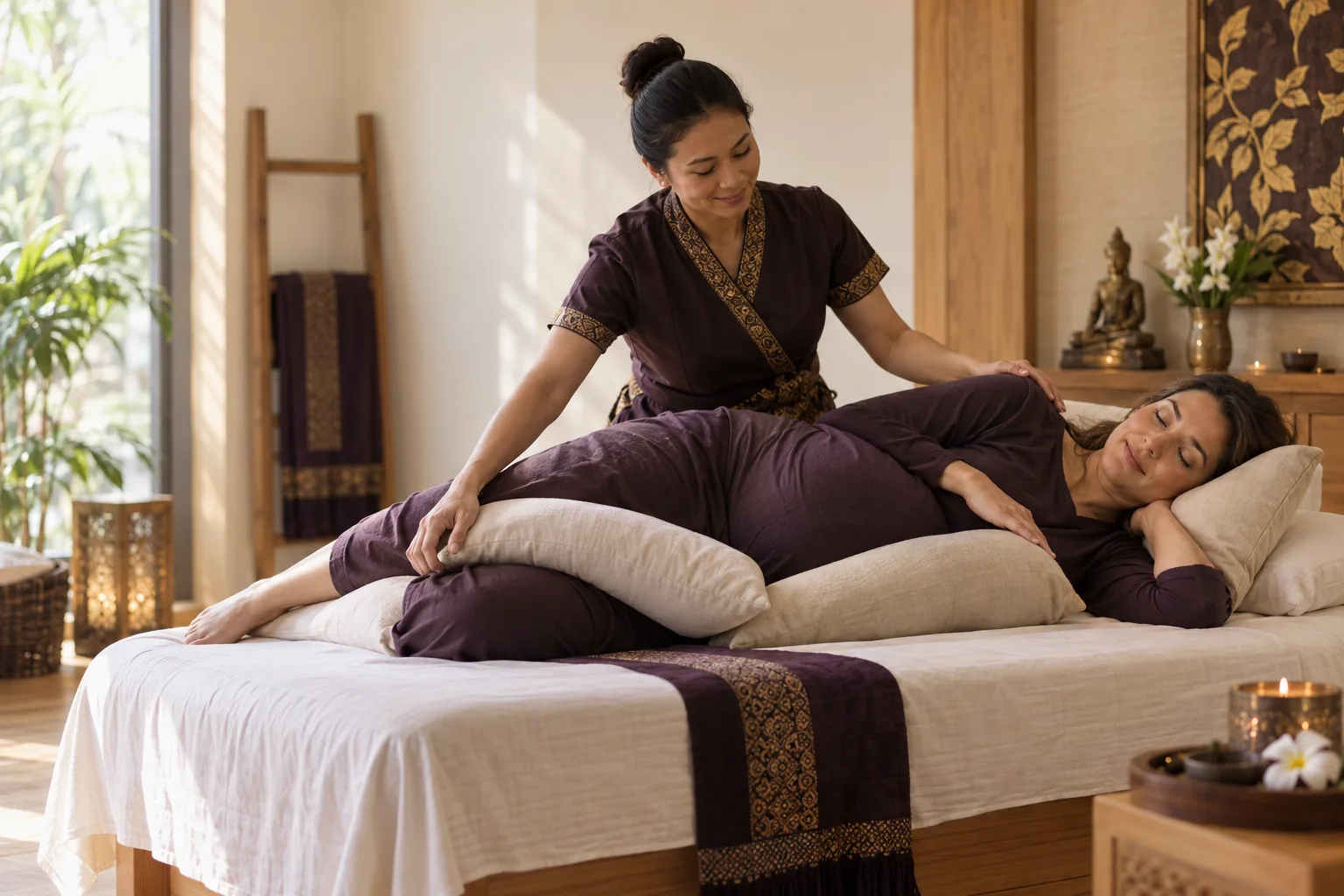
NaSiam mainly uses side-lying for pregnancy massage. Cushions support the abdomen, back, hips, and legs so that you do not have to hold tension to remain stable. The American College of Obstetricians and Gynecologists identifies side-lying as a suitable massage position during pregnancy.
A massage-table cut-out or lying on the abdomen is not required for a complete treatment. Comfort remains individual: if lying on one side does not feel right, support is changed or you turn to the other side. A more upright position may also suit a separate foot treatment.
Why not remain flat on the back?
Later in pregnancy, lying flat on the back can become uncomfortable for some people. Dizziness, nausea, breathlessness, or a sudden unpleasant feeling is always a reason to change position immediately. You do not need to wait for a predetermined number of minutes or a particular week.
How does pressure change?
Pregnancy massage at NaSiam is gentle. Pressure is introduced slowly and adjusted throughout the session. A technique may still feel clear, but sharp, burning, electrical, or increasing pain is not a desired outcome.
“No deep pressure” is often presented online as an absolute rule, while the real decision depends on area, health, pregnancy, and practitioner training. NaSiam does not turn pregnancy massage into a firm deep-tissue session. If you have a persistent problem or severe pain, first establish whether massage is appropriate at all.
Which areas require extra attention?
Feet, lower legs, back, and hips may feel tired, but visible symptoms need to be discussed first. A warm, red, painful, and one-sided swollen lower leg is not an area to “loosen up”. It may require prompt medical assessment.
The abdomen is also not treated as though ordinary muscle massage were automatically appropriate there. Treatment focuses on calm support and areas that are suitable after intake. Anyone seeking help for pelvic pain, instability, or a medical back problem may need a qualified physiotherapist or other healthcare professional instead.
First trimester: practice policy versus medical rule
NaSiam does not offer pregnancy massage during the first trimester. From the second trimester, treatment may be booked if the intake does not identify a reason to consult first or postpone.
This policy should not be interpreted as evidence that massage causes miscarriage, nor as a guarantee that every massage after twelve weeks is safe. It is a clear boundary within the service. Personal medical questions belong with the professional responsible for your maternity care.
When is massage not the first step?
Contact maternity care first if you have:
- a sudden increase in swelling of the face, hands, legs, or feet;
- severe headache, visual problems, or pain below the ribs;
- bleeding or leaking fluid;
- chest pain, breathing difficulty, or fainting;
- a warm, painful, and one-sided swollen leg;
- fever, infection, or feeling clearly unwell;
- severe, new, or rapidly increasing pain.
The NHS page on pregnancy symptoms that need help explains why sudden swelling and other warning signs should not be managed by waiting for massage.
What can treatment realistically offer?
An adapted massage can create a quiet moment, support you in a comfortable position, and help tired muscles feel temporarily more at ease. Some people feel relaxed afterwards; others mainly appreciate that they did not have to carry, sit, or move for a while.
NaSiam does not promise that pregnancy massage:
- treats fluid retention;
- shortens or induces labour;
- demonstrably improves circulation for parent or baby;
- prevents varicose veins;
- changes hormones or immunity;
- cures back, pelvic, or other medical problems.
These boundaries do not make treatment impersonal. They make clear what you are booking: wellbeing and comfort, not medical care.
How do you prepare for the appointment?
Mention when booking that you are pregnant and how far along you are. Wear comfortable clothing and tell us first if you are sensitive to fragrance or oil. Eat and drink as you normally do and according to care advice; no detox ritual or exceptional water intake is required.
Before travelling, check pregnancy massage prices and access and parking. If you are deciding between a complete treatment and focused attention to the feet, also read foot massage during pregnancy.
Frequently asked questions
Can I keep booking my ordinary massage?
It is better to choose the treatment explicitly offered as pregnancy massage. The appropriate intake, duration, cushions, and gentle approach are then planned from the start.
From when can I visit NaSiam?
From the second trimester as a practice policy. Always mention complications and medical monitoring beforehand.
Do I need a doctor’s note?
Not routinely. With a high-risk pregnancy, complications, or uncertainty, NaSiam may ask you to consult your midwife or doctor first.
Can I lie on my stomach?
You do not need to. NaSiam mainly uses supported side-lying.
Which duration is best?
There is no universally best duration. You can choose 60, 90, or 120 minutes. Let comfort and energy matter more than the idea that longer is automatically better.
Conclusion
An ordinary massage during pregnancy becomes an appropriate pregnancy massage when intake, position, support, pressure, and boundaries are consciously adapted. Choose the specific pregnancy massage at NaSiam and share relevant information before your appointment.
Author, reviewer and approver
Nalita Mangtaku
Thai massage therapist, owner & founder
Nalita Mangtaku has practised massage since 2009 and is the founder of NaSiam. Her favourite treatments are therapeutic Thai massage, sports massage, and relaxation massage. She describes her style as flowing, healing, and energetic.
Therapeutic, with clear boundaries
Our massages are non-medical wellbeing treatments adapted to tension, stiffness, fatigue, and the need for relaxation.
- We start with a short intake and adjust pressure, pace, and techniques to your comfort level and situation.
- Massage may support relaxation and temporary body comfort; it does not diagnose conditions or replace a doctor, physiotherapist, or rehabilitation.
- Always mention pregnancy, recent surgery, fever or infection, acute injury or inflammation, skin wounds, blood thinners or a bleeding disorder, and unexplained or increasing pain beforehand.
- Firm massage, deep tissue, and cupping require extra caution; cupping can cause temporary discoloration, scars, burns, or infections.
- Seek medical help for severe or rapidly increasing pain, numbness or weakness, clear swelling, chest pain, or breathing difficulty; do not wait for a massage appointment.
Sources for boundaries and precautions: NCCIH on massage safety, NCCIH on cupping, and ACOG on massage during pregnancy.
- Pregnancy
- Massage
- Choosing a treatment