
Authentic Thai massage: how to recognize the difference
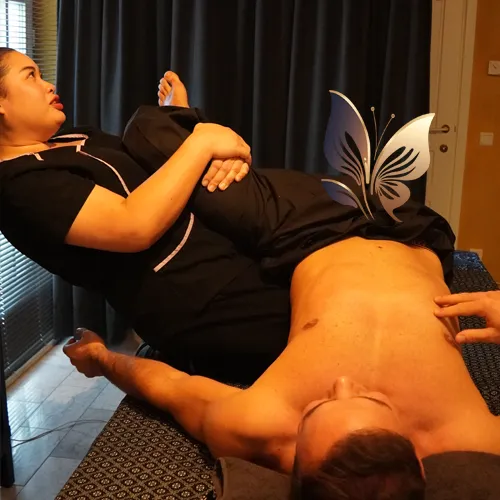
Anyone searching in Brecht, Brasschaat, or Schilde quickly finds dozens of places calling themselves Thai massage. Yet the name alone says very little. Authentic Thai massage is not something you recognize from a few Buddha statues, a calm playlist, or the word “traditional” on the menu. You recognize it through the quality of the intake, the technique, and the way your body is handled.
That distinction matters, especially if you are not simply looking for atmosphere but for a treatment that truly fits. In this article, you will learn how to tell the difference without becoming suspicious of everything or falling for overdone marketing. The point is not to dismiss other practices. The point is to help you choose better: what counts as real Thai expertise, what is mostly wellness packaging, and which signals build trust before you even lie down on the table or mat.
Key takeaways
- Authenticity mostly shows up in training, intake, technique, and communication, not in decoration.
- Not every Thai massage has to look exactly the same, but the goal and the chosen form do need to make sense together.
- A good therapist works professionally, asks about contraindications, and adjusts pressure.
- Very low prices, big promises, and a routine approach are all reasons to look a little more critically.
- In the Brecht area, it becomes easier to recognize stronger practices when their background and treatment style are visible in concrete terms.
Table of contents
- What makes authentic Thai massage truly authentic?
- Not every salon with “Thai” on the sign works to the same standard
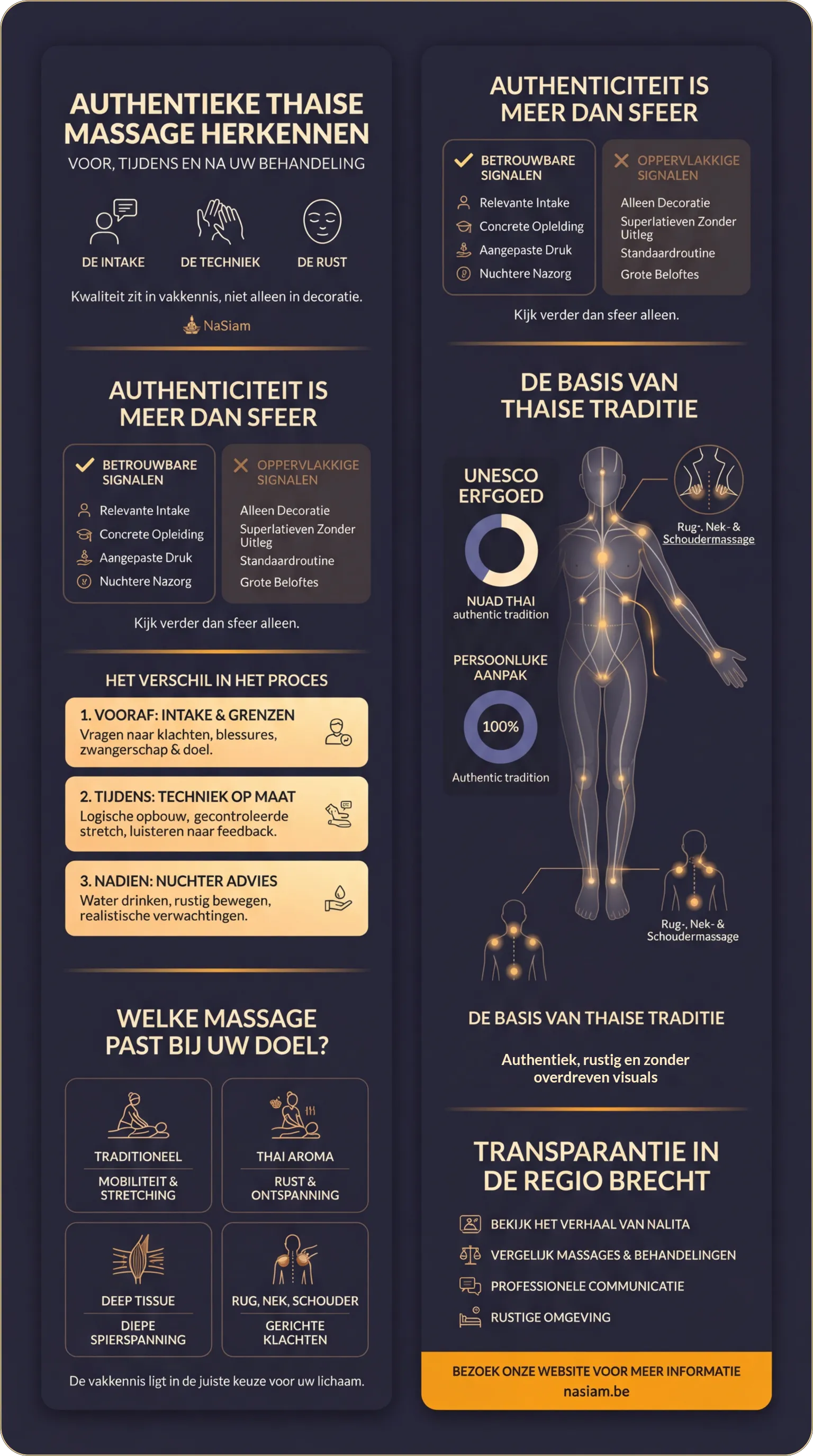
- How to recognize the difference before, during, and after the treatment
- Which Thai massage fits your goal?
- What should you look for locally in Brecht and the Voorkempen?
What makes authentic Thai massage truly authentic?
Thai massage is not a loose marketing label. It is a tradition with recognizable foundations: rhythmic pressure, mobilization, stretching, attention to body lines, and a respectful build-up. The UNESCO page on Nuad Thai does not describe that tradition as intangible cultural heritage by accident. That does not mean every session has to look identical. It does mean a practice should understand the roots of the method and be able to explain clearly why a certain approach fits your body and your goal.
Authenticity is more than a Thai atmosphere
Many people first look at scent, music, decor, or how “Eastern” a room feels. That may help you relax, but it says very little about the treatment itself. A salon can look warm and stylish while still working in a completely generic way. On the other hand, a more understated practice can be highly authentic because the technique is sound, the communication is clear, and professional boundaries are respected.
Authenticity is therefore not about decoration alone, but about consistency. The treatment feels intentional rather than random. You notice that the touch has a purpose, that pressure is not being applied carelessly, and that there is a real difference between relaxing, working with focus, and forcing. That makes the experience feel not only more credible, but usually safer and more effective too.
Training and method matter more than decoration
An authentic practice can usually explain who is treating you, where the training comes from, and which style is actually being applied. You can see that clearly in a treatment such as traditional Thai massage: not as a folkloric performance, but as a recognizable form of bodywork with its own rhythm and logic. Good authenticity is understandable. You do not need to be an expert yourself, but you should be able to understand why a therapist chooses one technique over another.
Authenticity is also not a museum piece. A strong practice does not blindly copy one fixed routine. It preserves the essence of Thai technique while still taking your body, your limits, and your goal into account. That is the difference between doing “something Thai” on the surface and actually working from real expertise.
Not every salon with “Thai” on the sign works to the same standard
The reality is simple: the label “Thai massage” covers very different experiences. Some salons mainly focus on general oil-based relaxation. Others are more spa and experience driven, while others work from a more complaint-focused bodywork approach. There is nothing wrong with that in itself, as long as it is clear what you are booking. The real problem starts when everything is called “traditional,” “therapeutic,” and “for everyone” at the same time, without any real explanation.
Surface signals say very little
A practice does not need to be suspicious just because it looks modern, has a short menu, or mainly offers relaxation. But a few things are worth taking as reasons to look more carefully:
- only superlatives such as “100% authentic” without any concrete explanation
- no clear information about who is treating you or what training stands behind it
- a menu where every treatment seems the same except for the name
- big promises about quick healing or guaranteed results
- a rushed atmosphere, vague communication, or pressure to book immediately
None of those points is a final red flag on its own. They are, however, good reasons to ask a few extra questions before making an appointment.
Reliable signals show up in behavior
A serious practice answers simple questions calmly: what kind of massage do you actually give, how is the pressure adjusted, what can I expect during a first session, and what happens if I respond sensitively? If you are still unsure about taking that first step, our guide to your first Thai massage helps sharpen the basic questions to ask. Reliability usually feels less spectacular, but much clearer: an honest answer, a calm tone, and no rush to push you into something.
You can also recognize quality in how a practice handles boundaries. A good therapist does not pretend massage solves everything, and does not act as if every client needs the same approach. That kind of realism is often a stronger sign of authenticity than any exotic packaging.
How to recognize the difference before, during, and after the treatment
The easiest way to recognize authenticity is not in an advertisement, but in the process itself. If you pay attention, you can usually tell before the treatment even starts whether a practice mainly runs on routine or really works in an adjusted and attentive way.
Before: intake and clear boundaries
In a proper Thai treatment, someone should first ask about complaints, sensitive areas, injuries, pregnancy, previous massage experience, and the effect you are looking for. If you are mainly coming in because of upper-back tension, for example, it makes sense for a practice to discuss a more focused back, neck, and shoulder massage or a more therapeutic direction rather than simply pushing the longest general session. Just as important: a good therapist also knows when massage should not be the first step.
An intake does not need to be long or heavy, but it does need to be relevant. If nothing is asked and the treatment is already decided before anyone knows your story, you already know that real tailoring is not the priority.
During: technique adjusted to you rather than repeated as a routine
An authentic Thai treatment follows a clear logic. Pressure is built up gradually, stretching is controlled, and your feedback matters. “Firm” is not a quality label by itself. In many cases, slow and precise pressure works better than brute force. The NCCIH page on massage therapy also highlights how important it is to discuss medical circumstances and to choose a trained practitioner.
If you say something feels too intense, the treatment should respond to that. If an area is clearly more sensitive, the technique should be adjusted. And if a movement makes no sense for your complaint, it should simply be left out. That sounds obvious, but it is exactly where many people feel the difference between routine work and treatment that is actually performed with attention.
After: realistic follow-up without oversized promises
Afterward, a strong practice usually gives simple and realistic guidance: drink some water, move gently, observe how your body responds, and mention it if something feels unusual. What you do not need are vague detox stories, absolute healing promises, or pressure to buy into a long package on the spot. An authentic practice tends to trust results and relationship more than accelerated selling.
That is also why aftercare says more than many people think. When a therapist stays clear about what massage can and cannot do, it may sound less spectacular, but it feels much more trustworthy.
Which Thai massage fits your goal?
Another persistent misunderstanding is that authenticity means there is only one correct Thai massage. The roots are traditional, but the application can differ depending on what you need. A practice that truly understands that stays faithful to the basics without pushing you into a form that may not suit your body at all.
Traditional if you want mobility, pressure work, and stretching
If you consciously want a more classical Thai experience, you will usually end up with rhythmic pressure, stretching, and bodywork with little or no oil. That often suits people who feel stiff, compact, or less mobile and can handle a more active treatment. The experience is very different from a standard relaxation massage, and that is exactly why it can be the more logical choice for some bodies.
Oil-based or therapeutic if your goal is different
If what you mainly need is calm and a softer pace, Thai aroma massage may be the better fit. If the tension sits more deeply in the muscles or connective tissue, deep tissue massage may be more logical. The authentic difference is not that a practice stubbornly repeats one style, but that it combines the Thai foundation with an honest choice for what your body needs today.
That requires nuance. A good practice does not automatically sell the strongest or most expensive option. It chooses the form that makes the most sense. That is why authenticity often feels calmer than people expect: less theatre, more focused attention.
What should you look for locally in Brecht and the Voorkempen?
In the area around Sint-Job-in-’t-Goor, you do not have to drive into the city center to find a careful practice, but local comparison is still worth it. Look less at who shouts the loudest and more at what is visible in concrete terms: who is treating you, how calm the setting feels, whether the menu is explained clearly, and whether people communicate professionally about boundaries, cleanliness, and expectations.
Transparency is a stronger quality signal than big words
If a practice makes it easy to see who is behind it, what that person’s background is, and how treatments are built up, that creates more trust than any slogan ever can. It is often through that kind of transparency that you quickly sense whether a place is built on substance or mainly on packaging. At NaSiam, we deliberately choose that kind of clarity: not by repeating the word “authentic” more loudly, but by being clear about approach, background, and what you can or cannot expect here.
A calm treatment starts before the first touch
Accessibility, the welcome, enough time between appointments, and an unrushed atmosphere make more difference locally than many people realize. An authentic treatment does not feel like a quick changeover between clients, but like a moment in which you are allowed to arrive, receive explanation, and not guess what is happening with your body. That too is part of the difference between a nice word and a credible experience.
Once you know what to look for, you compare differently. Then you stop focusing mainly on decoration and slogans and start looking at consistency instead: does the story match the treatment, the tone, the technique, and the way people work with your body? In the end, that is the most useful definition of authenticity.
Do you want to compare authentic Thai massage in a calm and practical way?
If you do not want to rely on attractive wording alone, transparency is usually the better starting point. Feel free to first look at Nalita’s story and background and then compare all massages & treatments at your own pace. That allows you to judge for yourself whether the style, the expertise, and the overall approach fit what you are looking for, without turning it into a sales pitch.
Frequently asked questions about authentic Thai massage
How do you recognize authentic Thai massage without being an expert yourself?
Pay less attention to decoration and marketing language, and more attention to training, intake, technique, communication, and a clearly professional setting. Authenticity is usually visible in the way the treatment is built up.
Does authentic Thai massage always have to be done without oil?
No. The traditional form is often done without oil and includes stretching, but an authentic practice can also work with oil when that fits the purpose of the treatment better. What matters more is that the chosen technique matches your question and is performed with skill.
Is a firmer massage automatically of higher quality?
No. More pressure is not the same as more expertise. A good therapist adjusts intensity to your body, your complaints, and your feedback during the session.
What kinds of questions should a good therapist ask before starting?
A proper intake should cover things like your complaints, sensitive areas, injuries, pregnancy, preferred pressure, and previous massage experience. That makes the treatment both safer and more focused.
What is the difference between Thai massage and a regular relaxation massage?
Thai massage more often uses pressure points, stretching, and a more structured build-up. A regular relaxation massage usually focuses more on calm and surface-level relaxation. Which one fits better depends on your goal.
Can you find reliable Thai massage in the Brecht area without driving into the city?
Yes. You can also find professional, calm, and transparent practices outside Antwerp. Focus on the therapist’s background, the intake, and the substance of the treatment rather than on location alone.
What should you do if most of your tension is in the neck and shoulders?
In that case, a focused treatment is often smarter than choosing a general full-body session at random. Discuss where the tension sits in advance so the technique can be adapted accordingly.

Author, reviewer and approver
Nalita Mangtaku
Thai massage therapist, owner & founder
Nalita Mangtaku has practised massage since 2009 and is the founder of NaSiam. Her favourite treatments are therapeutic Thai massage, sports massage, and relaxation massage. She describes her style as flowing, healing, and energetic.
Therapeutic, with clear boundaries
Our massages are non-medical wellbeing treatments adapted to tension, stiffness, fatigue, and the need for relaxation.
- We start with a short intake and adjust pressure, pace, and techniques to your comfort level and situation.
- Massage may support relaxation and temporary body comfort; it does not diagnose conditions or replace a doctor, physiotherapist, or rehabilitation.
- Always mention pregnancy, recent surgery, fever or infection, acute injury or inflammation, skin wounds, blood thinners or a bleeding disorder, and unexplained or increasing pain beforehand.
- Firm massage, deep tissue, and cupping require extra caution; cupping can cause temporary discoloration, scars, burns, or infections.
- Seek medical help for severe or rapidly increasing pain, numbness or weakness, clear swelling, chest pain, or breathing difficulty; do not wait for a massage appointment.
Sources for boundaries and precautions: NCCIH on massage safety, NCCIH on cupping, and ACOG on massage during pregnancy.