
First Thai massage? Everything you need to know before your visit
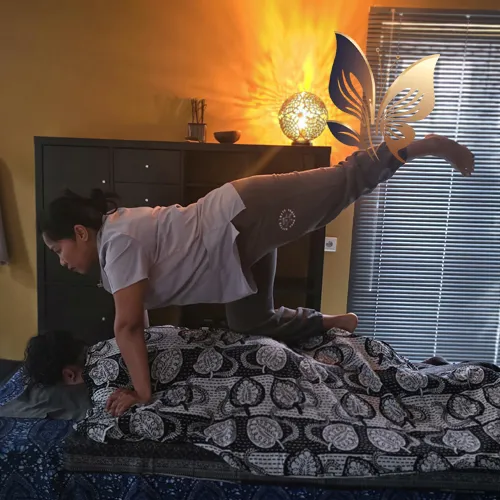
First Thai massage? everything you need to know before your first visit
What if the key to relieving persistent tension in your neck and back is not doing less, but choosing a more intentional form of bodywork?
The idea of a first Thai massage often raises normal questions. Will the stretching hurt? What should you wear? How do you know whether the atmosphere is professional and respectful? Those are exactly the kinds of questions this page is meant to answer.
This article helps you prepare calmly. You will learn what to expect from an authentic Thai massage, how to choose between traditional and oil-based styles, and what practical steps help you get more out of your first visit. If you are also looking for local information about NaSiam, you can find that on our homepage.
Key points
- Learn how Thai massage combines acupressure and stretching to release tension.
- Understand the difference between traditional Thai massage and Thai oil massage.
- Prepare well for your first session with practical tips about clothing, food, and communication.
- Learn what happens before, during, and after a first appointment.
- Understand why choosing a professional practice makes a difference.
Table of contents
- Your first Thai massage: what can you expect?
- The technique behind the tradition: how a session works
- Traditional Thai massage vs. Thai oil massage: what should a beginner choose?
- Practical tips for your first appointment: preparation and aftercare
- Why a professional practice makes the difference
Your first Thai massage: what can you expect?
If you are considering Thai massage for the first time, it helps to know that it is not just a passive relaxation treatment. Authentic Thai massage is a more active method that combines pressure work, stretching, and body awareness.
At a professional practice, your first session usually starts with a short intake. You discuss where you feel tension, how sensitive your body is to pressure, and whether there are any medical points of attention. That alone already makes a big difference, because it prevents you from ending up in a treatment that is too intense or not focused enough.
If you would like to know more about Nalita and the way NaSiam works before booking, you can also visit our about page.
Does Thai massage hurt if you are new to it?
Not necessarily. Thai massage can feel intense, especially on areas that have been tight for a long time, but it should not feel unbearable. The goal is to create more space in the body, not to force it. Communication is part of the treatment: if the pressure feels too strong, it should be adjusted.
The technique behind the tradition: how a session works
Traditional Thai massage is often described as a mix of acupressure, stretching, and assisted movement. Instead of only using oil and long gliding strokes, the therapist works more specifically with pressure points, rhythmic compression, and gentle mobilization.
That makes Thai massage useful for people who feel stiff, overloaded, or less mobile than before. The treatment is often experienced as more structural than a standard relaxation massage, because it does not only calm the muscles but also works on how the body is holding tension.
Acupressure and stretching
During a session, the therapist may use hands, thumbs, forearms, or elbows to work more precisely on tight areas. Stretching is always adapted to the person in front of them. The goal is not to test flexibility, but to help the body move more freely again.
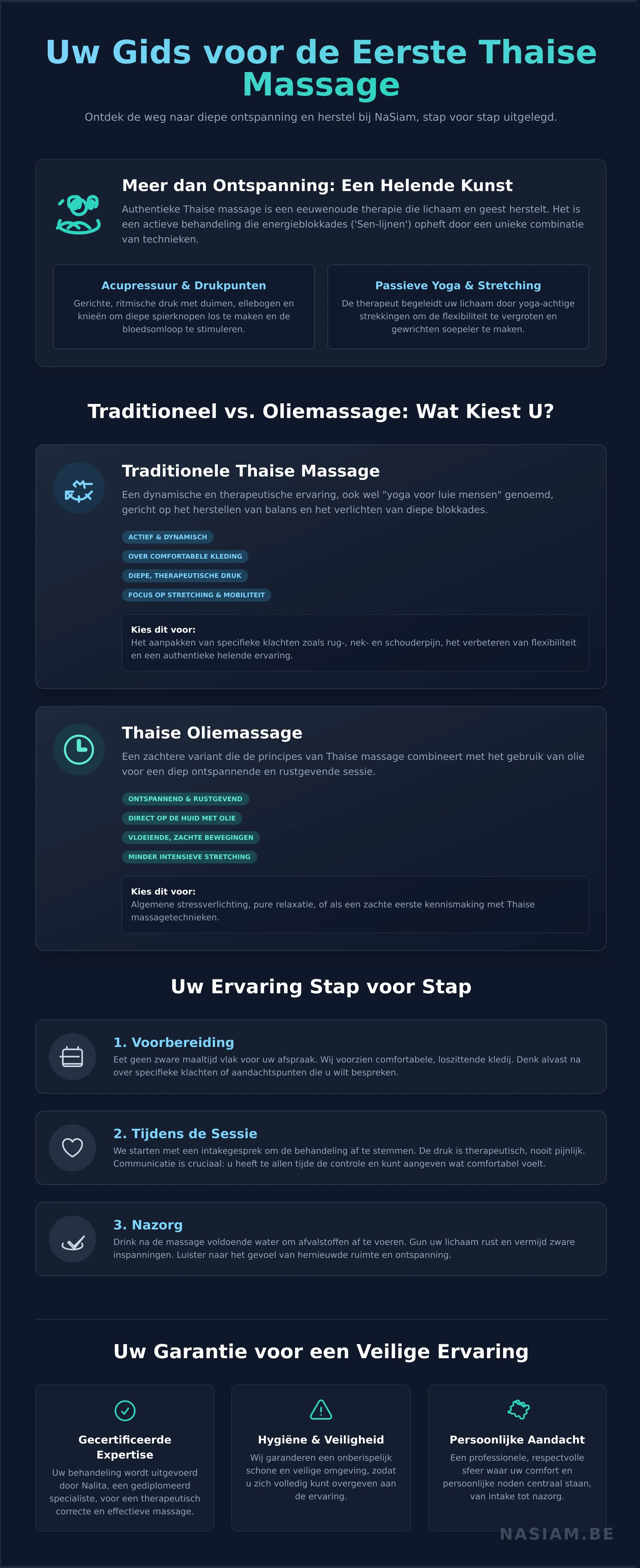
Traditional Thai massage vs. Thai oil massage: what should a beginner choose?
One of the most common beginner questions is whether to choose a more traditional session or a gentler oil-based treatment.
Traditional Thai massage
Traditional Thai massage usually works with more stretching and pressure points. It often feels more active and is a logical option if you mainly want to work on stiffness, mobility, or recurring muscular tension.
Thai oil massage
Thai oil massage is softer and more flowing. It is often a better choice if your main goal is to relax deeply, calm your nervous system, and slow down physically and mentally.
If you are unsure
If you are unsure, that is perfectly normal. In that case, it often helps to compare the massages & treatments first. That way, you choose based on goal and comfort rather than by guessing from a treatment name.
Practical tips for your first appointment: preparation and aftercare
Good preparation and simple aftercare often make the difference between a session that is just pleasant and one that feels genuinely useful.
Before the massage
- Wear comfortable clothing and avoid a heavy meal right beforehand.
- Arrive a few minutes early so you can settle in calmly.
- Mention injuries, pregnancy, pain-sensitive areas, or other important details in advance.
- Think briefly about what you want from the session: deeper release, softer relaxation, or local focus.
After the massage
- Drink enough water afterward.
- Give your body a little time instead of going straight into intense effort.
- Mild sensitivity can be normal after a deeper session.
- If you want a more structural effect, it may help to think in terms of rhythm rather than a one-off session.
Our guide to soreness after a Thai massage explains what can be a short-lived response and when it is better to seek advice.
If you want to continue practically after reading this guide, the homepage and the price list are the most useful next pages.
Why a professional practice makes the difference
Your first Thai massage is not only about technique. It is also about who treats you, how boundaries are handled, and whether there is room for explanation, intake, and aftercare.
A professional practice makes those things visible. At NaSiam, we therefore explain not only the treatments, but also the person behind the practice, accessibility, and practical information. If you would like to compare that calmly first, the homepage, access & parking, and the about page are the most relevant pages.
What should you look for when booking?
These points are useful for a first appointment:
- Is it clear which treatments are offered and what they are suitable for?
- Can you mention complaints, sensitivity, or pregnancy in advance?
- Are accessibility, parking, and prices easy to find?
- Does the practice communicate clearly and professionally, without vague promises?
Your first step toward more calm
You are now better prepared for what a first Thai massage usually involves. You know what to expect, how to prepare, and what to look for when choosing a practice. That usually makes the first step much easier.
If you already know roughly which treatment fits you, continue to massages & treatments. If you would rather start with local practical information, go to the homepage.
If you still want a broader explanation of techniques and differences first, our complete guide to authentic Thai massage is the logical next read.
Frequently asked questions about your first Thai massage
Do i need to undress completely for a Thai massage?
That depends on the type of session. For a traditional treatment, comfortable clothing or clear guidance from the practice is normal. For oil-based treatments, privacy and coverage should remain clear and respectful at all times.
Is Thai massage painful if i am not flexible?
No. A good treatment is adapted to your body and your limits. You may feel a deep stretch or a strong pressure point, but the session should stay workable and safe.
What is the difference between a regular massage and a Thai massage?
Thai massage usually combines pressure points, stretching, and more active bodywork. Many regular relaxation massages work more with oil and surface-level muscle calming.
How often should i book a massage for the best result?
That depends on your goal. For maintenance, many people choose a monthly rhythm. For recurring complaints, shorter intervals can be useful at first.
Are there medical reasons why i should avoid Thai massage?
Yes. Fever, acute inflammation, recent surgery, certain skin conditions, or other medical concerns should always be mentioned beforehand. When in doubt, consult your doctor first.

Author, reviewer and approver
Nalita Mangtaku
Thai massage therapist, owner & founder
Nalita Mangtaku has practised massage since 2009 and is the founder of NaSiam. Her favourite treatments are therapeutic Thai massage, sports massage, and relaxation massage. She describes her style as flowing, healing, and energetic.
Therapeutic, with clear boundaries
Our massages are non-medical wellbeing treatments adapted to tension, stiffness, fatigue, and the need for relaxation.
- We start with a short intake and adjust pressure, pace, and techniques to your comfort level and situation.
- Massage may support relaxation and temporary body comfort; it does not diagnose conditions or replace a doctor, physiotherapist, or rehabilitation.
- Always mention pregnancy, recent surgery, fever or infection, acute injury or inflammation, skin wounds, blood thinners or a bleeding disorder, and unexplained or increasing pain beforehand.
- Firm massage, deep tissue, and cupping require extra caution; cupping can cause temporary discoloration, scars, burns, or infections.
- Seek medical help for severe or rapidly increasing pain, numbness or weakness, clear swelling, chest pain, or breathing difficulty; do not wait for a massage appointment.
Sources for boundaries and precautions: NCCIH on massage safety, NCCIH on cupping, and ACOG on massage during pregnancy.
- Massage
- Wellness
- Health