
deep tissue massage for tight muscles: why it works so well
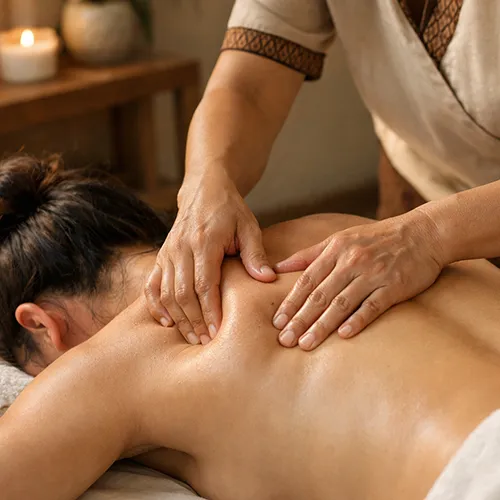
If you spend long hours behind a screen, drive often, or train intensely, you will usually notice where tension settles first: the neck, between the shoulder blades, the lower back, or deep into the legs. deep tissue massage for tight muscles is not a surface-level wellness treatment, but a more targeted approach for zones that keep feeling hard, stiff, or limited in movement.
If you are looking for something that goes beyond simple relaxation, this guide helps you understand what a deep tissue massage actually does, when it makes sense, and why it can be so effective for stubborn muscular tension. If you mainly want practical information, rates, and direct booking, go straight to our deep tissue service page.
Key takeaways
- deep tissue works on deeper patterns of tension in muscles and connective tissue, not only on the top muscle layer.
- It is often chosen for stubborn tension in the neck, shoulders, back, hips, and legs.
- Slow, focused pressure usually works better for tight muscles than fast, surface-level massage.
- Good communication during the session matters: intensity can be useful, forcing is not.
- Not every complaint calls for deep tissue. Sometimes a more targeted or gentler treatment is the better fit.
Table of contents
- Why deep tissue massage for tight muscles often feels so effective
- Which complaints often lead people to choose deep tissue?
- What can you expect during a targeted session?
- When is deep tissue the better choice and when is a gentler treatment smarter?
- Practical tips to get more benefit from deep tissue
Why deep tissue massage for tight muscles often feels so effective
Tight muscles rarely appear overnight. In most cases, tension and overload build gradually. A body that works too long in the same position, recovers too little, or stays under constant stress starts to protect itself by tightening up. As a result, certain areas do not only feel tired. They start to feel hard, shortened, or difficult to relax.
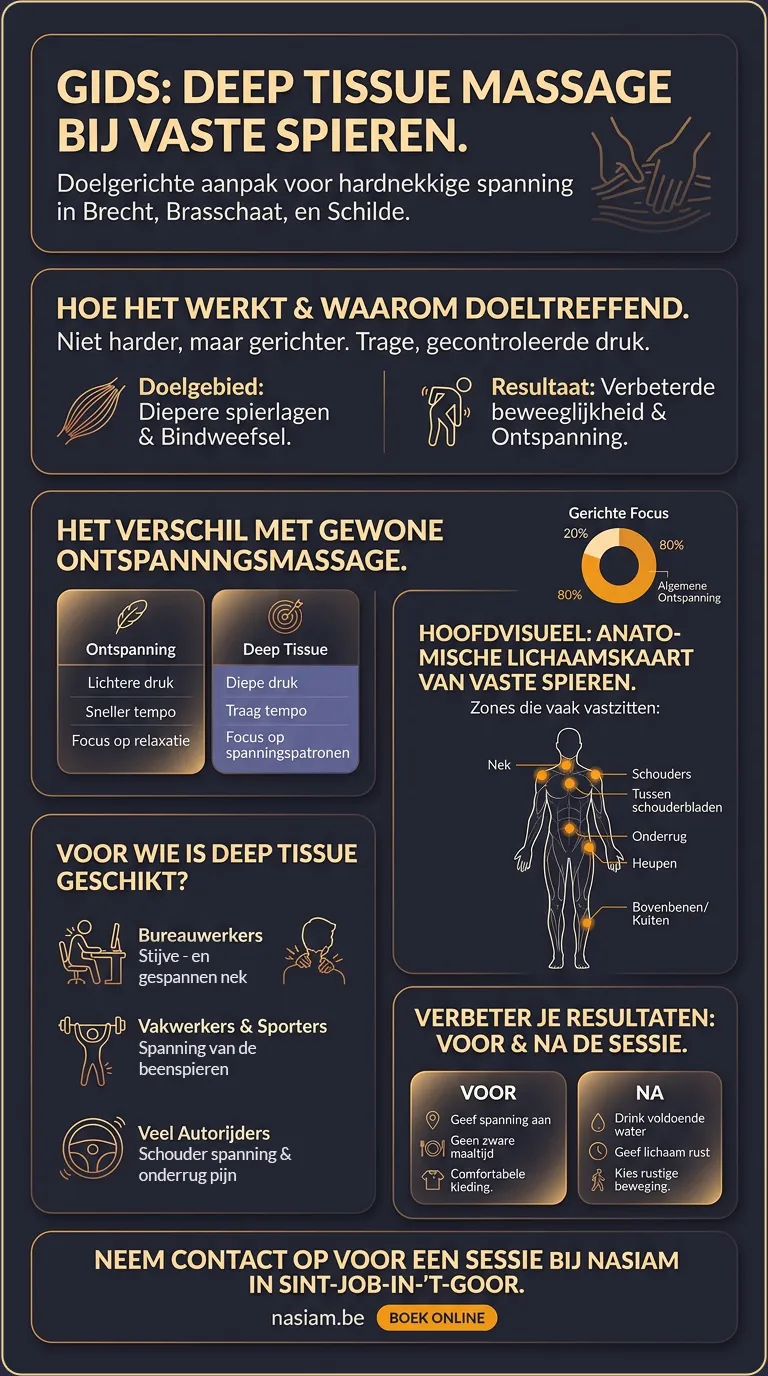
deep tissue works on exactly that difference. The treatment uses slower, more deliberate pressure to approach deeper muscle layers and the connective tissue around them. The goal is not to work as hard as possible, but to give the tissue enough time to release. If you want more context on that distinction, our page about therapeutic massage vs. deep tissue explains it more clearly.
What do people mean by tight muscles?
When people say their muscles feel tight, they usually mean areas that feel tense, stiff, or limited in how they move. Think of shoulders that seem constantly raised, a back that never fully lets go, or calves that remain hard even at rest. That pattern can come from desk work, sports load, stress, repetitive movement, or a combination of all of those.
Why slow, focused pressure often works better
When tension has been there for a while, the body often responds better to steady, controlled pressure than to quick movement. Slow pressure gives the muscles a chance not to brace even more. That is one of the reasons deep tissue is often experienced as especially effective: not because it is automatically harder, but because it is more precise.
Which complaints often lead people to choose deep tissue?
deep tissue is usually chosen when tension has become too stubborn for a purely relaxing approach. That often includes:
- neck and shoulder overload from desk work
- tight lower back muscles
- stiff hips or legs after physical load
- recurring local knots that keep returning
Tight neck and shoulders from desk work
If you sit a lot or spend most of the day looking at a screen, tension often builds in the neck, upper back, and shoulders. In that case, deep tissue can help by working more directly on the areas that remain contracted for too long.
If your complaints are mainly concentrated in the upper body and you want an even more local approach, our back, neck, and shoulder massage may also be worth considering.
Lower back, hips, and legs after physical load
Athletes and people with physically demanding work often choose deep tissue when muscles stay tight after exertion. In those cases, a deeper and slower treatment can make more sense than an ordinary relaxation massage.
What can you expect during a targeted session?
A good deep tissue session does not begin with pressure. It begins with the intake. First we look at where the tension is, how long it has been there, and how your body feels on that particular day. That prevents standard treatment.
A proper intake avoids routine work
During the session, the work usually builds from broader to more specific. First the tissue gets time to warm up, then the focus shifts to the areas that keep feeling restricted. That makes the session more deliberate and more useful.
Pressure is adjusted, not imposed
deep tissue can feel intense, but it should never turn into a battle. Your breathing, muscular response, and feedback all help determine how much pressure is actually useful. Good deep tissue is not a display of force. It is a precise interaction between therapist and body.
When is deep tissue the better choice and when is a gentler treatment smarter?
deep tissue is not automatically the best choice for everyone. If you mainly need a deep release in muscles that have stayed tense for weeks or months, deep tissue often makes sense. If, on the other hand, you are mostly overstimulated, exhausted, or very sensitive to touch, a gentler treatment may be more effective.
Choose deep tissue when you need targeted release
deep tissue is often a good fit when surface-level relaxation no longer feels sufficient. You see that with shoulders that keep locking up, a lower back that repeatedly tightens, or legs that stay heavy after physical effort.
Choose gentler work when stress and sensitivity are leading
If your body mainly needs calm and a softer reset of the nervous system, a more flowing treatment may fit better. In that case, a Thai aroma massage is often the more logical choice.
Practical tips to get more benefit from deep tissue
How you begin a session and what you do afterward both affect how your body processes the treatment.
Before the appointment
Try not to eat a heavy meal right beforehand, and be clear on arrival about where the tension is, what feels sensitive, and what kind of pressure you are comfortable with. You can find practical information for a calm arrival on our access & parking page.
After the appointment
After a session, it helps to drink enough water and give your body some time. Gentle movement usually makes more sense than going straight into heavy effort. If you want to plan more concretely, continue to the price list.
Deep tissue for tight muscles: a more targeted next step
If you notice that your neck, shoulders, back, or legs keep tightening up again and that an ordinary relaxation massage no longer gives enough relief, deep tissue massage for tight muscles is often the logical next step.
If you want to see whether this treatment fits your needs, visit our deep tissue massage page. If you are still unsure between broader complaint-focused work and pure deep tissue, also read therapeutic massage vs. deep tissue. Planning more concretely can be done through the price list.
Frequently asked questions about deep tissue massage for tight muscles
Is deep tissue massage for tight muscles always painful?
No. The treatment can feel intense on areas that have been tight for a long time, but it should never feel unbearable.
How do you know if deep tissue is the right choice?
deep tissue is often chosen when muscles stay hard, stiff, or limited in movement despite rest, stretching, or a regular relaxation massage.
Is soreness after the massage normal?
Mild after-sensitivity can happen, especially when stubborn tension has been treated. That usually settles on its own.
How often should you schedule a session?
That depends on how long the tension has been there and how your body responds. With recurring complaints, a more regular rhythm at first often makes sense.

Author, reviewer and approver
Nalita Mangtaku
Thai massage therapist, owner & founder
Nalita Mangtaku has practised massage since 2009 and is the founder of NaSiam. Her favourite treatments are therapeutic Thai massage, sports massage, and relaxation massage. She describes her style as flowing, healing, and energetic.
Therapeutic, with clear boundaries
Our massages are non-medical wellbeing treatments adapted to tension, stiffness, fatigue, and the need for relaxation.
- We start with a short intake and adjust pressure, pace, and techniques to your comfort level and situation.
- Massage may support relaxation and temporary body comfort; it does not diagnose conditions or replace a doctor, physiotherapist, or rehabilitation.
- Always mention pregnancy, recent surgery, fever or infection, acute injury or inflammation, skin wounds, blood thinners or a bleeding disorder, and unexplained or increasing pain beforehand.
- Firm massage, deep tissue, and cupping require extra caution; cupping can cause temporary discoloration, scars, burns, or infections.
- Seek medical help for severe or rapidly increasing pain, numbness or weakness, clear swelling, chest pain, or breathing difficulty; do not wait for a massage appointment.
Sources for boundaries and precautions: NCCIH on massage safety, NCCIH on cupping, and ACOG on massage during pregnancy.