
Always tight muscles? 6 signs your body is holding on to tension

If you spend long days behind a screen, drive often, or train regularly, you may recognize the pattern immediately: you wake up with a tight back, your shoulders already feel heavy, and by evening your body feels even less relaxed than it did in the morning. Always tight muscles can start to feel like something that simply comes with a busy life. Yet that is not always true.
Sometimes it is just normal muscular fatigue after effort. But if stiffness keeps returning, limits the way you move, or settles in the same places again and again, there is a good chance your body is holding on to a broader tension pattern. In this article, you will see 6 signals that can point to that pattern, what often keeps it going, and when a more targeted approach can help more than stretching harder.
Key takeaways
- Tight muscles are not only caused by hard exercise; desk work, stress, and too little recovery often play a major role as well.
- Recurring stiffness in the neck, shoulders, back, or legs usually points to a pattern rather than a one-off load.
- If stretching only helps briefly, there is often more going on than simple short muscles.
- Regular movement, posture, recovery, and focused body care usually matter more than forcing things from time to time.
- Massage can make sense when tension keeps returning to the same places and your body no longer seems to release it naturally.
Table of contents
- Why tight muscles say more than simple fatigue
- 6 signs behind always tight muscles
- How your body gets stuck in this pattern
- What helps when your body feels stuck?
- When massage can make sense for tight muscles
Why tight muscles say more than simple fatigue
Muscle stiffness is not unusual in itself. One day you feel it after a demanding workout, another day after sitting for hours in the same position or sleeping poorly. What matters is how often it happens and how it behaves. Temporary stiffness tends to ease again. But if you feel the same tightness almost every day, or if your neck, shoulders, back, or hips keep tightening in the same way, it becomes less about one isolated reaction and more about a body that is bracing itself too often.
Temporary stiffness is not the same as being stuck
After effort, a muscle can feel tired or sensitive. That is not the same as being chronically stuck. With temporary recovery stiffness, you usually improve after some gentle movement, sleep, or time. With a longer-standing pattern, the same zones tend to tighten again quickly.
Your body sometimes protects for longer than necessary
What many people describe as “my body feels stuck” is often a combination of muscular tension, reduced ease of movement, and a nervous system that struggles to switch off. A body that stays under tension for too long rarely becomes looser by waiting alone.
6 signs behind always tight muscles
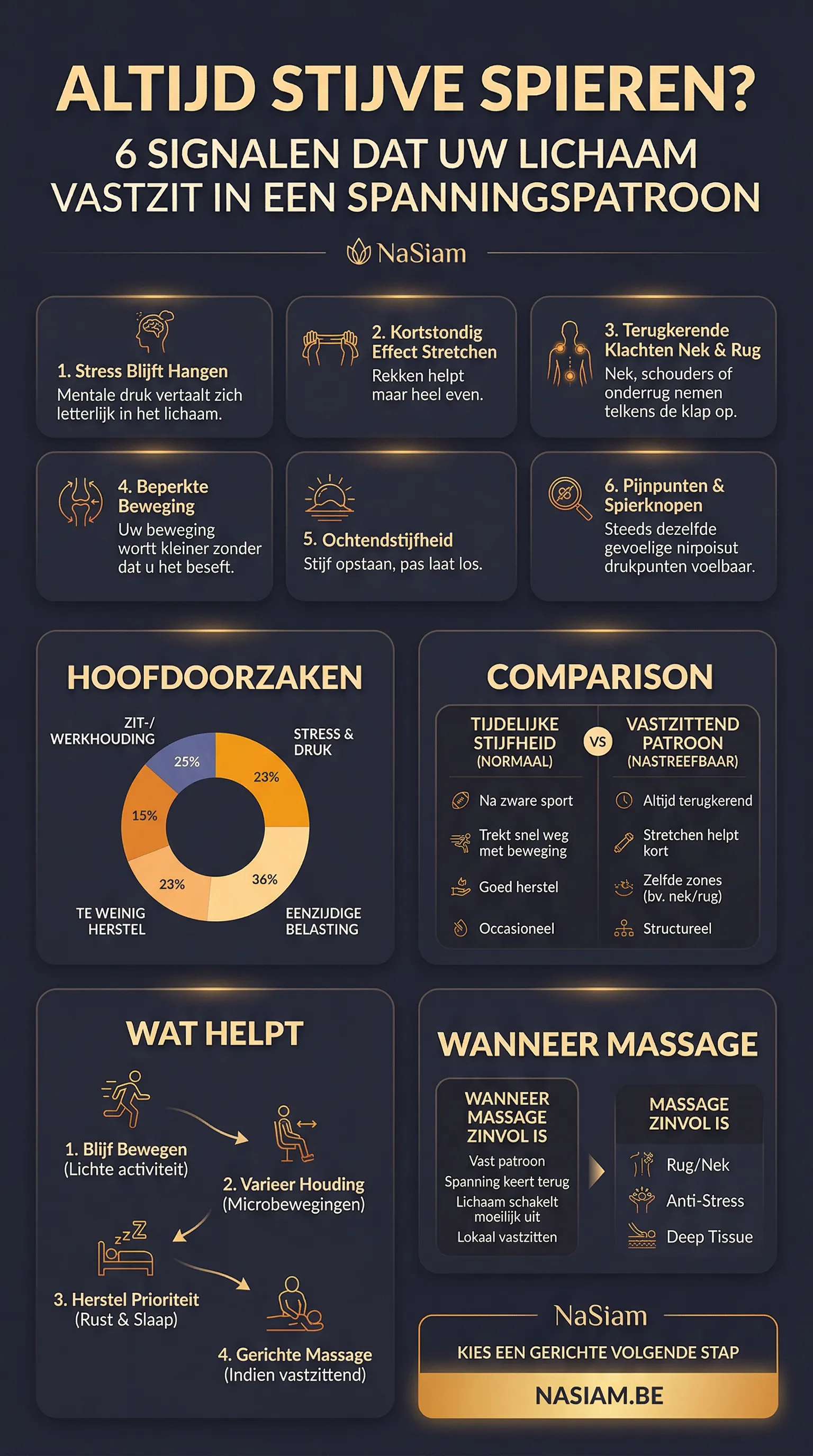
If you are wondering whether your stiffness is still “normal,” these are useful signals to watch. If you recognize several of them at once, there is a greater chance your body is holding tension in a more structural way.
1. you wake up stiff and only loosen up later in the day
One clear sign is when your body already feels restricted as soon as you get out of bed. Your back is slow to start, your shoulders feel heavy immediately, or your legs seem to need a warm-up before they move normally.
2. stretching helps, but only for a moment
Stretching can feel good in the short term, but if the same tight neck or hip returns soon afterward, the cause is usually broader than simple tightness.
3. your neck, shoulders, or lower back keep taking the hit
A body that is stuck in tension often chooses the same weak links. If that load mainly sits in the upper body, a focused back, neck, and shoulder massage often makes more sense than a random relaxation session.
4. your range of motion gets smaller without you really noticing
Another clear sign is that you start avoiding movement without fully realizing it. You rotate less easily in the car, reach overhead less freely, or only notice during exercise that your hips or hamstrings do not move as openly as before.
5. stress settles physically in your body
Not all tight muscles come from physical effort. Mental pressure, restlessness, and always being “on” often translate into the body very clearly. In those cases, more pressure is not automatically better. That is why, with stress-based tension, an anti-stress massage may fit better than immediately choosing the strongest treatment.
6. you keep feeling the same pressure points or muscle knots
Recurring sensitive spots in the shoulders, back, glutes, or legs are often a final sign that the tension is no longer disappearing on its own. If that tension feels stubborn and more compact or deep, a targeted deep tissue massage may make sense.
How your body gets stuck in this pattern
Rarely because of one single cause. In most cases, it is the sum of several smaller things that continue for long enough.
Desk work, commuting, and one-sided load
For many people, the combination of screen work and travel is one of the biggest triggers. You sit for long periods, move too little in between, and use the same muscle groups to keep your head, shoulders, and lower back stable.
Pushing on too long instead of recovering in time
Active people can get stuck in this pattern too. Exercise is valuable, but if training, work, and home life together leave too little room for recovery, muscles stay “on” more often.
Choosing the wrong type of treatment
Sometimes the pattern also continues because the approach does not really match the cause. That is why it helps to reassess what your body is actually asking for. Our article on how to choose the right massage helps make that distinction clearer.
What helps when your body feels stuck?
The good news is that tight muscles often respond well to relatively simple adjustments, especially if you do not wait until everything feels completely blocked.
Keep moving regularly, even when you feel stiff
Short walks, gentle mobility work, and changing position more often usually do more than trying to force everything loose once a week.
Look beyond stretching alone
If your muscles keep feeling tight, there is often a lot to gain from building in small moments of movement throughout the day, staying hydrated, and making your workspace less demanding.
Pay attention to signs that go beyond ordinary stiffness
If your stiffness comes with fever, swelling, muscle weakness, severe pain, or persistent neck stiffness, medical follow-up is the safer next step.
When massage can make sense for tight muscles
Massage becomes especially relevant when it is not only meant to feel pleasant, but also to serve a purpose. In other words, when tension keeps returning, your body struggles to switch between effort and recovery, or one zone stays tight despite moving and stretching.
Then the main question is not “Which massage is the strongest?” but “Which treatment fits this pattern?” If your tension is mainly local in the neck and shoulders, something focused is often smarter. If the tension feels deeper and more stubborn, a firmer approach may fit. If you want to understand that distinction better, our article on therapeutic massage vs. deep tissue adds useful nuance. If your tension feels especially deep and compact, our guide to deep tissue massage for tight muscles helps make that more concrete.
Always tight muscles? choose a more targeted next step
If you recognize several signals from this article, there is a good chance your body is not only tired, but structurally holding tension. In that case, it usually helps to stop choosing at random and look more deliberately at what your body needs: something local, something deeper, or something more calming.
If you want to compare that first, start with our page about how to choose the right massage. If you want to plan more concretely, continue to the price list. With tight muscles, a short intake and the right balance of pressure and focus often make more difference than simply booking “another massage.”
Frequently asked questions about tight muscles
When are tight muscles still normal, and when are they not?
Temporary stiffness after exercise, a long drive, or sleeping in an awkward position is common. If your muscles feel tight almost every day, your range of motion stays limited, or you also notice swelling, fever, muscle weakness, or severe pain, medical evaluation is the wiser next step.
Can massage help with tight muscles?
It can, especially when tension keeps returning to the same areas and your body no longer seems to let go on its own.
What if stretching only helps for a short time?
Then the problem is often broader than simple tightness. Posture, overload, stress, recovery, and movement habits may all be playing a role.
Is deep tissue always the best choice for tight muscles?
No. deep tissue is especially useful for stubborn, deeper-feeling tension. If your body mainly feels overstimulated, tired, or sensitive, a gentler option is often the better fit.

Author, reviewer and approver
Nalita Mangtaku
Thai massage therapist, owner & founder
Nalita Mangtaku has practised massage since 2009 and is the founder of NaSiam. Her favourite treatments are therapeutic Thai massage, sports massage, and relaxation massage. She describes her style as flowing, healing, and energetic.
Therapeutic, with clear boundaries
Our massages are non-medical wellbeing treatments adapted to tension, stiffness, fatigue, and the need for relaxation.
- We start with a short intake and adjust pressure, pace, and techniques to your comfort level and situation.
- Massage may support relaxation and temporary body comfort; it does not diagnose conditions or replace a doctor, physiotherapist, or rehabilitation.
- Always mention pregnancy, recent surgery, fever or infection, acute injury or inflammation, skin wounds, blood thinners or a bleeding disorder, and unexplained or increasing pain beforehand.
- Firm massage, deep tissue, and cupping require extra caution; cupping can cause temporary discoloration, scars, burns, or infections.
- Seek medical help for severe or rapidly increasing pain, numbness or weakness, clear swelling, chest pain, or breathing difficulty; do not wait for a massage appointment.
Sources for boundaries and precautions: NCCIH on massage safety, NCCIH on cupping, and ACOG on massage during pregnancy.